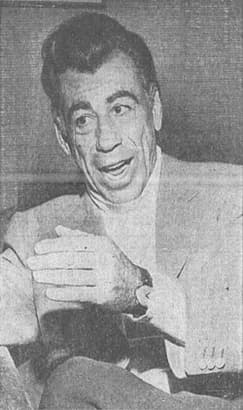
Kirk Kerkorian
Trans International Airlines (TIA)
A pioneering figure in the aviation industry, Kirk Kerkorian founded Trans International Airlines (TIA) in the 1960s, shaping air travel with innovative approaches to service and operations. His journey began at age 19, where a $1 flight in a Piper plane ignited his passion for aviation, leading him to establish a company that served over 1 million passengers annually at its peak. Kerkorian's business philosophy emphasized integrity, famously stating that breaking a handshake deal was never worth short-term financial gain, a principle that resonates with entrepreneurs today. He believed in maintaining control over investments, advocating for significant bets in business ventures to maximize potential returns. His approach to entrepreneurship, likening life to a craps game, underscored the thrill of taking calculated risks in pursuit of success.
Core Principles
culture
Avoid ostentatious displays of wealth. Simplicity in appearance and possessions maintains focus on business rather than status.
Kirk wore no jewelry, no gold chains, no expensive watches. He kept a simple Timex without a band in his pocket, drove a Ford Taurus or Jeep Cherokee, and traveled without an entourage. This simplicity reflected his values.
“He abhorred ostentatious displays of wealth. He kept a simple Timex watch without a band in his pants pocket.”
Refuse comps and perks, even at your own establishments. Maintaining personal integrity and equality with others is worth more than free goods.
Despite owning multiple hotels and casinos, Kirk personally paid for all meals and rooms. He carried his own bags, drove ordinary cars, and refused comps as a matter of principle.
“He refused comps, personally paying for meals and rooms, even at his own hotels.”
True charity is anonymous giving with no expectation of recognition or return. Public philanthropy defeats the purpose of charity.
Kirk donated millions anonymously to people in need, viewing donations with attached credit as transactions rather than charity. When he received criticism for insufficient public giving to Armenia, he established a foundation to meet expectations while maintaining his principle of anonymous giving.
“Anonymous donations to an anonymous person was like the purest form of giving. If you wanted something in return like you wanted your name on a building or you wanted a plaque or an award, then it's not charity like it's a transaction.”
finance
Leverage can make you appear brilliant in good times and foolish in bad times. High debt coupled with high interest rates creates existential risk.
Kirk accumulated $50 million in high-interest rate debt to finance his Las Vegas projects during favorable market conditions. When negative publicity emerged and the stock market crashed, he became vulnerable to insolvency and was forced to sell assets at catastrophic losses.
Protect your downside while maintaining uncapped upside. Structure deals with escape hatches and contingency plans.
When Kirk needed $5 million for jets, he negotiated with Douglas Aircraft that if military contracts failed to materialize, he could lease the planes to commercial carriers. This capped his downside risk while preserving unlimited profit potential if contracts came through.
Never default on debt and always pay what you owe. Your reputation for financial reliability opens future doors.
Kirk never defaulted on loans throughout his career. This reputation earned him the trust of Bank of America manager Walter Sharp, who advocated for unprecedented $2 million and $5 million loans when other banks would not.
“Kirk never defaulted on a loan.”
hiring
Hire one person with a single, clear mandate. Simplicity of purpose drives execution.
When Kirk bought his first jet for TIA, he hired aviation executive Glenn and gave him one job: keep the DC-8 meter running and make money flying it. Glenn did not need strategic oversight or complex instructions, just a clear mission.
“Glenn's mandate was to keep the meter running on the DC-8.”
innovation
Relentlessly apply existing skills to new problems. Use experience from one domain to create advantage in another.
Kirk learned to fix and resell used cars, making $15 profit per vehicle. He applied this exact skill to surplus military aircraft: buy derelict planes, refurbish them, and sell for massive markups of $90,000 to $250,000 per plane in 2018 dollars.
leadership
Demand punctuality from yourself and others. Lateness signals disrespect and lack of discipline. Zero tolerance establishes standards.
Kirk was obsessively punctual and would not accept lateness from anyone. He once left a woman he was dating behind in France when she failed to arrive at his private jet on time, leaving her to arrange her own return to the US.
Cultivate low tolerance for mistakes in high-stakes environments. Demanding excellence when lives or fortunes depend on it saves lives and money.
As a flight instructor before WWII, Kirk was famous for the mantra, 'There are old pilots and there are bold pilots. There are no old, bold pilots.' His demanding approach to precision training built his reputation for safety.
“There are old pilots and there are bold pilots. There are no old, bold pilots.”
Never invest in a business you do not control. Outside investment without operational control leads to frustration and poor outcomes.
Kirk learned this after losing $50,000 on a 1% casino stake that he had no control over. The lesson shaped his entire investing philosophy: ownership meant nothing without the ability to run the business himself.
“I learned then not to invest in a business that I didn't run.”
Your word is your bond, and honor agreements even when better offers emerge. Breaking a handshake deal is never worth short-term financial gain.
When Kirk's second-in-command received a $15 million higher offer for a company after a handshake agreement with another buyer, Kirk refused the better deal and honored the original commitment. He taught that agreements made in good faith must be kept regardless of new circumstances.
“Well, did you agree? Like, did you make an agreement yesterday? Did you shake and say you're going to sell the company? He's like, yes. Kirk's like, well why are we even talking?”
Build long-term relationships with key business contacts. Today's peer becomes tomorrow's decision-maker who can provide greater opportunities.
Kirk negotiated plane deals with Douglas Aircraft executive Jackson McGowan years before they needed to work together. When Kirk needed $5 million in financing for jets, McGowan, now general manager of the aircraft division, secured unprecedented financing based on their history and Kirk's reputation.
mindset
Maintain extreme discipline in personal habits to handle business pressure. Regular exercise, moderate consumption, and structured routines build resilience.
Kirk jogged daily, played tennis regularly, ate small portions, drank moderately, and kept an early sleep schedule. This discipline allowed him to maintain clarity while managing billions in assets and multiple high-stakes transactions.
“Kirk had always been health conscious and disciplined about regular exercise. He jogged daily and played tennis religiously.”
Purpose transforms learning. Knowledge becomes essential when it directly supports a clear goal.
Kirk dropped out of school because mathematics bored him as an abstract subject. Once he decided to become a pilot and realized navigation and fuel calculations were matters of life and death, he eagerly pursued math through night school classes.
“Math was essential to all aspects of aviation. From navigating to tracking fuel consumption, a pilot's computations were serious matters. Life or death matters.”
Accept losses without second-guessing past decisions. Learn the lesson and move forward completely.
When Kirk lost $100 million due to SEC denial of his second public offering during a stock market crash, he refused to blame external forces. He accepted responsibility, identified his vulnerability (becoming overleveraged), and moved forward without dwelling on what-if scenarios.
“Kirk blamed Kirk. He had let himself become vulnerable. Like any sane gambler, Kirk never looked back.”
Acknowledge that humans experience ups and downs regardless of external success. Wealth and achievement do not prevent depression or emotional struggle.
Kirk experienced a significant depression following his first marriage's end in 1951. Despite his growing wealth, he withdrew from work and family, eventually seeking electroshock therapy. This taught him that success does not immunize against human vulnerability.
Learn from family financial collapse. Use poverty and instability as education in what not to repeat, not as permanent limitation.
Kirk's father repeatedly acquired over $1 million in assets during the 1920s but became overleveraged and lost everything through repeated foreclosures. Kirk studied this failure and built a philosophy of financial responsibility and conservative debt management.
“Debt is what broke his father four decades earlier.”
resilience
Take calculated personal risks alongside financial risks when launching new ventures. Willingness to risk your own life demonstrates conviction to others.
Kirk ferried planes over the treacherous North Atlantic during WWII with a one in 40 chance of crashing. He later piloted surplus planes from Hawaii to South America himself, nearly dying on one flight. This personal risk-taking built investor confidence.
Willingness to work strenuous jobs and outlast competitors proves character and builds capability. Endurance separates committed founders from casual workers.
At age 17, Kirk worked high-altitude digging and clearing paths at Sequoia National Park, work that caused many to quit. He persisted while farm boys from more privileged backgrounds faltered, teaching himself that determination trumps inherited advantage.
Take on demanding physical work to learn valuable skills. The effort to acquire knowledge increases its value.
Kirk hitchhiked 85 miles to Florence Poncho Barnes' flight school in the Mojave and offered to work dawn to dusk at farm chores in exchange for pilot training. He earned his commercial pilot license in six months and immediately received a job offer.
“He was short on education and money for flight lessons, but he was willing to work hard. If that meant getting up at dawn to milk cows, slop hogs, and muck out the barn Kirk was ready to start immediately.”
simplicity
Simplify deal structures to avoid lawyer complexity. Clear agreements reached through conversation beat complex contracts reviewed by committees.
When selling MGM to Ted Turner, Kirk proposed a simple structure: approximately $1.5 billion all cash, no contingencies, close in two weeks. Though the deal took eight months, the initial framework was understandable and actionable.
“It had to be all cash, no contingencies, and a no-outs commitment. And the deal had to be closed in two weeks.”
strategy
Start with equity, not just wages. Ownership of business assets generates real wealth, while salaries alone never make you rich.
After years as a pilot and instructor earning good money, Kirk realized pilots make salaries but businessmen own assets. He transitioned from flying Cessnas to owning a charter airline, which he sold for $104 million.
“Pilots don't make big money. Businessmen do.”
Play the long game when building business relationships. Initial small deals with potential partners often lead to much larger opportunities years later.
Kirk purchased used cars and resold them at small profits. This business introduced him to the charter business. The charter business introduced him to Las Vegas. Las Vegas led to hotel ownership. Each step built toward his eventual billionaire status.
When you have a good bet, bet the limit. Small bets provide inadequate returns and eliminate the thrill of true entrepreneurship.
Friends called Kirk a deal junkie. Whether at the craps table or negotiating table, he believed in placing significant bets rather than modest ones. He invested nearly all proceeds from stock offerings into land and real estate ventures in Las Vegas.
“The smaller your bet, the more you lose when you win. Besides, what's the point and where's the thrill winning a small wager?”
First identify a market inefficiency, then work backwards to capture it. Find scattered value before anyone else recognizes its pattern.
Kirk discovered that surplus military planes abandoned in Hawaii could be profitably ferried to mainland US and South America at $90,000 to $250,000 per aircraft. Few people had the flying skills and capital to execute this arbitrage.
Frameworks
The School of Hard Knocks
A learning system based on real-world survival, manual labor, and facing consequences rather than classroom education. Kirk advanced through poverty, evictions, physical work, and direct business involvement. Each experience taught resilience, resourcefulness, and practical problem-solving that formal education could not provide.
Use case: When formal education is unavailable or insufficient, or when you need to develop practical competence quickly in high-stakes environments.
The Arbitrage Vertical Stack
Identify an inefficiency at one level of a value chain, build capability at that level, then expand up and down the chain. Kirk started by fixing cars, expanded to buying and reselling them, then applied the same principles to planes, eventually building airlines and selling them for billions.
Use case: When you have a skill or insight about how to capture value that others miss, stack related business models to increase scale and profit.
The Asset Valuation Cycle
Buy undervalued assets during chaos or confusion, improve operational efficiency, wait for market recovery, then sell at peak value. Kirk bought TIA back from Studebaker for $2.5 million when they were desperate, took it public when stock was rising, then sold pieces strategically.
Use case: When markets are dislocated, competitors are distressed, or external pressure forces sellers to accept disadvantageous terms.
The Single Mandate Hiring
Hire a skilled person for one specific, measurable role with a clear objective. Do not assign strategy, committee work, or multiple competing priorities. Trust execution on a single mission. Kirk hired Glenn to 'keep the meter running' on his jet, nothing more.
Use case: When you need rapid scaling of a specific capability and want to avoid bureaucracy, diluted accountability, or over-complication.
The Reputation for Leverage Payoff
Build an impeccable financial reputation through consistent loan repayment and punctual payment of all obligations. Bankers and business partners will extend credit and financing at better terms based on proven reliability. Kirk never defaulted, opening doors to unprecedented financing.
Use case: When you need to borrow large sums and cannot offer traditional collateral, or when you want favorable terms and structures from lenders.
The Downside Protected Bet
Structure deals so that your downside is capped through options, contingencies, or exit clauses, while your upside remains uncapped. If the bet fails, you lose only what you wagered. If it succeeds, you capture unlimited returns.
Use case: When entering new markets, launching capital-intensive ventures, or making bets where success probability is unknown.
Stories
Kirk discovered flight at age 19 while working as a day laborer installing wall furnaces for 45 cents per hour. For one dollar, a coworker offered him a ride in a two-seater Piper plane. The moment the engine roared and the plane lifted, Kirk was smitten. He abandoned his plan to become a professional boxer and committed entirely to aviation, working multiple jobs to pay for flight lessons.
Lesson: A single moment of exposure to a new possibility can redirect your entire life. Remain open to discovering your true passion, and commit fully when it appears.
Kirk had two dollars and sixty cents after a night moving massive rocks at MGM Studios. Thirty years later, he owned MGM Studios outright, generating two hundred sixty thousand dollars per day in profit. The progression from rock mover to studio owner illustrates the compounding effect of small wins, strategic thinking, and long-term patience.
Lesson: Long-term perspective transforms poverty into opportunity. The work you do today, no matter how humble, teaches skills and networks that become invaluable tomorrow.
When Kirk needed to learn to fly but had no money, he hitchhiked eighty-five miles to Florence Poncho Barnes' flight school in the Mojave Desert and proposed a trade: he would work from dawn to dusk milking cows, slopping hogs, and mucking barns in exchange for pilot training. Six months later, he had his commercial pilot license and a job offer.
Lesson: Resourcefulness and willingness to work eliminate barriers created by lack of capital. Find people who value your effort and make them a proposition that benefits both parties.
Kirk lost ninety percent of his net worth when International Leisure stock crashed from sixty-five dollars to less than six dollars and fifty cents during a market downturn. He was forced to sell assets at catastrophic losses to cover high-interest debt. When asked about the loss, he said, 'I got a good kick in the ass.' He then immediately identified his mistake (overleveraging), committed to never repeating it, and moved forward without looking back.
Lesson: The ability to accept losses without regret and extract lessons without dwelling on them separates successful long-term builders from those broken by setbacks.
Kirk called up Ted Turner to sell him MGM Studios. He said he wanted around one point five billion dollars, but regardless of price, it had to be all cash, no contingencies, no outs, and closed in two weeks. Though the deal took eight months to actually close, the structure was so simple and clear that both men knew exactly what they were negotiating. No ambiguity, no lawyer complications.
Lesson: Clarity of terms closes faster than complex contracts. Negotiate like a businessman, not like a lawyer. Simple agreements that both parties understand and can act on reduce friction and accelerate deals.
When Kirk's second-in-command received a fifteen million dollar higher offer for a company after making a handshake agreement, he called Kirk to ask what to do. Kirk asked if they had made an agreement yesterday. Yes. Then why are we even talking, Kirk said, and hung up the phone. Kirk did not take the fifteen million dollars. His word and reputation for keeping agreements was worth more than the immediate gain.
Lesson: Your reputation for integrity is your most valuable asset. Honoring commitments even when better offers emerge builds trust that enables bigger deals in the future.
Kirk was working close to an airfield in the mid-1930s during the Great Depression. He saw surplus military DC-3 aircraft abandoned in Hawaii after World War II. He realized that if he could pilot these planes to the mainland or South America, they would be worth two to three times their purchase price. He bought seven planes, gutted them to install extra fuel tanks, piloted them himself over dangerous ocean routes, and sold them for profits of ninety thousand to two hundred fifty thousand dollars per plane.
Lesson: Identify market inefficiencies that others cannot or will not exploit. Combine your skills (piloting) with market knowledge (plane values) and capital (purchasing power) to capture the gap.
Kirk made forty-five cents per hour installing wall furnaces. From his first flight in a Piper plane, he knew he had to become a pilot. He worked as a bouncer at a bowling alley bar for extra money and enrolled in night school math classes. Previously, algebra bored him and he failed math classes. Now, understanding that navigation and fuel calculations were life-and-death matters, he mastered the mathematics he once rejected.
Lesson: Purpose transforms the value of knowledge. Abstract learning becomes urgent and engaging when directly connected to a meaningful goal you are committed to achieving.
Notable Quotes
“Life is a big craps game. I've got to tell you it's all been fun.”
Summary of his approach to life and business, viewing major life decisions and financial risks as a series of exciting gambles.
“I was just overwhelmed by the excitement of the little town.”
His reaction upon first seeing Las Vegas, which became the central focus of his most significant investments.
“There are old pilots and there are bold pilots. There are no old, bold pilots.”
His repeated mantra as a flight instructor, emphasizing precision and safety in high-risk aviation work.
“I learned then not to invest in a business that I didn't run.”
His core lesson after losing fifty thousand dollars on a passive casino investment where he had no control over operations.
“The smaller your bet, the more you lose when you win. Besides, what's the point and where's the thrill winning a small wager?”
His philosophy on risk-taking and leverage, shared with casino owner William Clark of the Desert Inn.
“Pilots don't make big money. Businessmen do.”
Realization at age thirty-five when his annual income broke one hundred thousand dollars from plane sales, teaching him the difference between earning wages and building equity.
“I thought after the war, God, if only I could get up to having fifty thousand dollars, that would be great. Then it was one hundred thousand dollars. It just keeps going.”
Reflection on his escalating net worth, noting that he had no plan to become a billionaire and was surprised by his accumulation of wealth.
“Did you agree? Like, did you make an agreement yesterday? Did you shake and say you're going to sell the company? He's like, yes. Kirk's like, well why are we even talking?”
His response when learning his second-in-command received a higher offer after making a handshake agreement, demonstrating his unwillingness to renege on commitments.
“I hate even that. I like to call my own shots. It's my place more than Baron's and Conrad Hilton's, so I'm not going to dance to their tune, and they can go whistle.”
His rare public display of temper when forced to share management control of the International Hotel after losing ninety percent of his investment.
“Kirk blamed Kirk. He had let himself become vulnerable.”
His response to losing one hundred million dollars when the SEC denied his second public offering, refusing to blame external circumstances.
Frequently Asked Questions
What are Kirk Kerkorian's key business principles?▼
Kirk Kerkorian's core principles include: Avoid ostentatious displays of wealth. Simplicity in appearance and possessions maintains focus on business rather than status.. Refuse comps and perks, even at your own establishments. Maintaining personal integrity and equality with others is worth more than free goods.. True charity is anonymous giving with no expectation of recognition or return. Public philanthropy defeats the purpose of charity.. Founder Almanac has cataloged 26 total principles from Kirk's career.
What can entrepreneurs learn from Kirk Kerkorian?▼
Key lessons from Kirk Kerkorian include: A single moment of exposure to a new possibility can redirect your entire life. Remain open to discovering your true passion, and commit fully when it appears.. Explore 8 stories and 6 frameworks from Kirk's experience.
What is Kirk Kerkorian known for in business?▼
A pioneering figure in the aviation industry, Kirk Kerkorian founded Trans International Airlines (TIA) in the 1960s, shaping air travel with innovative approaches to service and operations. His journey began at age 19, where a $1 flight in a Piper plane ignited his passion for aviation, leading him to establish a company that served over 1 million passengers annually at its peak. Kerkorian's business philosophy emphasized integrity, famously stating that breaking a handshake deal was never worth short-term financial gain, a principle that resonates with entrepreneurs today. He believed in maintaining control over investments, advocating for significant bets in business ventures to maximize potential returns. His approach to entrepreneurship, likening life to a craps game, underscored the thrill of taking calculated risks in pursuit of success.
More Aviation & Aerospace Founders
Want Kirk's advice on your business?
Our AI has studied Kirk Kerkorian's biography, principles, and decision-making frameworks. Ask any business question.
Start a conversation