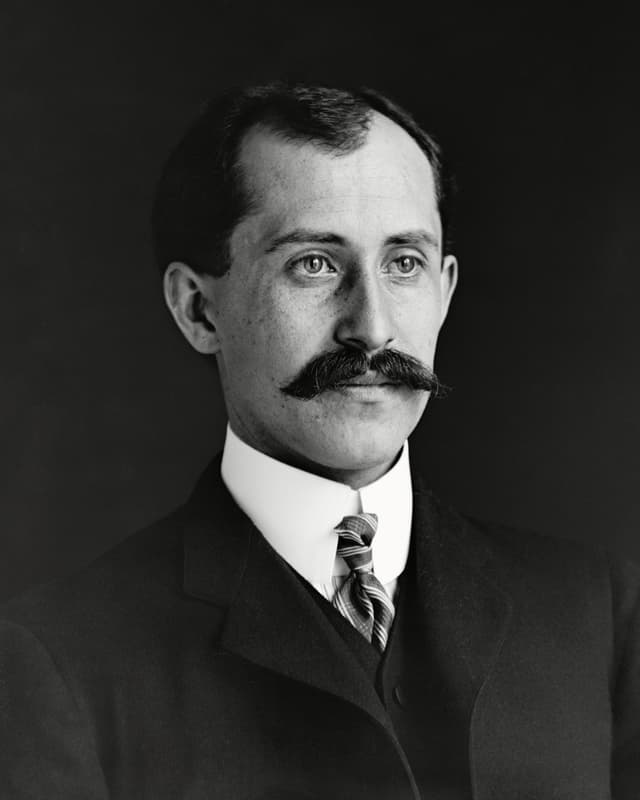
Wilbur Wright
Wright Brothers / Wright Cycle Company
A pioneer in aviation, Wilbur Wright co-founded the Wright Brothers, a company that played a crucial role in the development of powered flight. His relentless pursuit of innovation led to the first successful powered flight on December 17, 1903, at Kitty Hawk, North Carolina, marking a significant milestone in human history. Emphasizing the importance of learning through experience, he believed that theoretical knowledge must be validated by practice, a principle that resonates with today's entrepreneurs. Wright's focus on thorough mastery over impatience and external pressures serves as a powerful reminder for modern business builders navigating challenges. His insight that “the man who wishes to keep at the problem long enough to really learn anything positively must not take dangerous risks” continues to inspire cautious yet determined perseverance in the face of adversity.
Core Principles
competitive advantage
Never underestimate your competitors, especially those you do not know about or have not yet encountered. Assuming you are so far ahead that others cannot catch up leads to strategic blindness and vulnerability.
The Wright Brothers believed they were so technologically superior that no competitor could threaten them within five years. However, Glenn Curtiss and designers like Louis Blériot made rapid progress that the Wrights refused to acknowledge. By the time they recognized the threat, Curtiss had already surpassed them in business success and innovation, particularly with engine design and practical aircraft applications.
“No lead is insurmountable if you stop running before you reach the finish line.”
culture
Being relentlessly industrious with your core team is more valuable than bringing in many collaborators. Deep partnership and focus often outperform distributed effort.
Wilbur and Orville were virtually inseparable. They lived in the same house, worked together six days a week, ate meals together, kept money in a joint bank account, and thought together. When they invited other collaborators to Kitty Hawk at Octave Chanute's suggestion, they found that having visitors actually slowed their progress. Once the visitors left, 'the brothers were on their own again, and in 10 days of practice, they made more glides than in all the preceding weeks.' The external help, though well-meaning, was a distraction. Their greatest strength came from their unified partnership and shared mission.
“They were remarkably self-contained. They were ever industrious, and they were virtually inseparable.”
focus
Allowing yourself to be distracted by crowds, attention, and well-intentioned people's demands causes you to lose focus on the details that matter most. When performing complex technical work, you must examine and verify everything yourself rather than trusting others' carefulness.
After a crash that killed test pilot Thomas Selfridge and severely injured Orville, Wilbur reflected that he had tried to warn Orville. The crash occurred because Orville had delegated fastening the screws rather than checking them himself. Wilbur noted that thousands of well-intentioned people surrounding Orville consumed his time and strength, causing him to lose focus on the details. This inattention had dire physical consequences.
“I realized that he would be surrounded by thousands of people who, with the most friendly intentions in the world, would consume his time, exhaust his strength, and keep him from having proper rest.”
Follow your energy and obsession. Rearrange your life to work on what naturally captivates your mind, even if you must hire others to handle your day job.
As the Wright Brothers became increasingly obsessed with solving the problem of flight, they hired Charlie Taylor to run their bicycle business so they could concentrate on their flying studies and experiments. Wilbur noted: 'Our minds became so obsessed with it that we could do little other work.' Rather than abandon their income source, they delegated the day job to a capable manager and freed themselves to pursue their true mission. This allowed them to maintain financial stability while dedicating their mental energy to their primary passion.
“Our minds became so obsessed with it that we could do little other work.”
Do not rush through difficulties before fully understanding and overcoming them. Impatience, competitive pressure, and financial constraints should not override the need for thorough mastery.
Wilbur Wright refused to be hurried through any difficulty before he had done everything in his power to understand and overcome it. Even when waiting crowds grew impatient or competitors pressed, he maintained his deliberate pace and standards.
“Neither the impatience of waiting crowds, nor the sneers of rivals, nor the pressure of financial conditions, not always easy, could induce him to hurry over any difficulty before he had done everything in his power to understand and overcome it.”
Do not waste time criticizing the work of competitors or others in your field. Mind your own business and let your work speak for itself. Your philosophy will be evident in what you build.
When repeatedly asked to comment on the experiments of Alexander Graham Bell, Samuel Langley, and other aviation pioneers, both Wright brothers refused to make critical or belittling comments. Wilbur stated: 'It is very bad policy to ask one flying machine man about the experiments of another. Because every flying machine man thinks that his method is the correct one.' Instead, they focused entirely on their own path. After Langley's public humiliation and failure, the Wrights expressed respect for his work and the moral courage he showed in pursuing the problem despite ridicule. They believed their philosophy and methods would be evident through what they built, not through their criticism of others.
“It is very bad policy to ask one flying machine man about the experiments of another because every flying machine man thinks that his method is the correct one.”
Do not rush through difficulties before fully understanding and overcoming them. Impatience, competitive pressure, and financial constraints should not override the need for thorough mastery.
Wilbur Wright refused to be hurried through any difficulty before he had done everything in his power to understand and overcome it. Even when waiting crowds grew impatient or competitors pressed, he maintained his deliberate pace and standards.
“Neither the impatience of waiting crowds, nor the sneers of rivals, nor the pressure of financial conditions, not always easy, could induce him to hurry over any difficulty before he had done everything in his power to understand and overcome it.”
innovation
Learn through direct experience and trial and error rather than relying solely on theory. Theory must be validated through practice to be trustworthy.
The Wright Brothers emphasized that you must mount the machine and become acquainted with its tricks through actual trial. While they read extensively, they ultimately had to discover most solutions themselves. Their preference for learning by doing led them to reject expert guidance that did not match their experimental results.
“Men had to learn to manage in order to fly and there were only two ways. One is to get on him and learn by actual practice how each motion and trick may be best met.”
Finding the contrarian solution by doing the exact opposite of your competitors can yield breakthrough innovations. When everyone else moves in one direction, examine whether moving in the opposite direction solves the problem more elegantly.
All aviation competitors at the time focused on making aircraft as stable as possible, trying to prevent rolling. Wilbur observed that birds actually maintain control by twisting their wingtips to manage roll, not by preventing it. He realized that inherent instability, properly managed through active control, was superior to passive stability. This counterintuitive insight became the key breakthrough that made the Wright Flyer successful.
“Within weeks, Wilbur had his first great epiphany, a counterintuitive deduction. He came to understand that the best way to achieve stability in flight was to make an aircraft inherently unstable.”
Learn through direct experience and trial and error rather than relying solely on theory. Theory must be validated through practice to be trustworthy.
The Wright Brothers emphasized that you must mount the machine and become acquainted with its tricks through actual trial. While they read extensively, they ultimately had to discover most solutions themselves. Their preference for learning by doing led them to reject expert guidance that did not match their experimental results.
“Men had to learn to manage in order to fly and there were only two ways. One is to get on him and learn by actual practice how each motion and trick may be best met.”
Seek input from the eminent dead through reading. Access the accumulated knowledge of those who came before you. Build on their work rather than starting from scratch.
When Orville was recovering from typhoid fever, Wilbur began reading extensively about Otto Lilienthal and other aviation pioneers. He then wrote a letter to the Smithsonian Institution requesting all available materials on powered flight, saying 'I wish to avail myself of all that is already known.' They studied the works of Lilienthal, Octave Chanute, J. Bell Pettigrew, and Louis-Pierre Mouillard. Wilbur was so inspired by Mouillard's 'The Empire of the Air' that he considered it 'one of the most remarkable pieces of aeronautical literature ever published.' Reading their words transformed idle curiosity into active zeal for the work.
“I wish to avail myself of all that is already known.”
leadership
Conflict and vigorous debate lead to better solutions than harmony-seeking. Encourage critical disagreement with your partners. A good scrap brings out new ways of looking at things.
Wilbur and Orville could disagree to the point of shouting, sometimes arguing for an hour or more without reaching agreement. Yet each would often change to the other's original position overnight. After heated arguments, they would come to work the next day with one saying 'I've been thinking about it, you're right, let's do it your way.' Wilbur believed in this approach, stating he liked a good scrap because it brought out new ways of looking at things and helped round off corners. This approach mirrors Jeff Bezos's philosophy that when choosing between agreement and conflict, he takes conflict every time because it yields better results.
“I believe in a good scrap. It brought out new ways of looking at things and it helped round off corners.”
mindset
Problems that benefit all of mankind are worth solving even when they require centuries of accumulated effort. The persistence of a problem across generations indicates its importance and the magnitude of benefit that solving it will create.
The fact that achieving flight had been pursued for over 1,500 years, by countless civilizations and the greatest minds in history, indicated both the profound difficulty and the immense value that solving it would create. The Wright Brothers recognized this weight of importance and committed their lives to solving it, understanding that success would benefit all humanity.
“Achieving human flight might well be considered the oldest and most profound of all human aspirations.”
Reread and revisit important ideas multiple times over years. Your understanding deepens as you grow, and old ideas reveal new meaning.
Wilbur read Animal Mechanism by Marley once as a boy, then reread it intensely years later when his focus shifted to flight. He also reread Mouliard's work multiple times. Each reading yielded deeper insights because he had grown and his context had changed.
Reread and revisit important ideas multiple times over years. Your understanding deepens as you grow, and old ideas reveal new meaning.
Wilbur read Animal Mechanism by Marley once as a boy, then reread it intensely years later when his focus shifted to flight. He also reread Mouliard's work multiple times. Each reading yielded deeper insights because he had grown and his context had changed.
Neither try to be anything other than yourself. Authenticity and consistency in character matter more than trying to impress others.
Neither Wilbur nor Orville Wright tried to be anyone other than themselves. Despite their extraordinary work, they remained humble, courteous, and genuine in their manner. They were perfect gentlemen, never drank hard liquor, smoked, or gambled. When asked to give his first public speech about their work, Wilbur was reluctant and told his sister it would be pathetic. Yet his speech was described as 'the Book of Genesis of the twentieth century Bible of aeronautics' because it was authentic Wilbur Wright: straightforward, clear, and direct. Wilbur lived largely in his own world, seemed a little strange to some due to his deep concentration, but never pretended to be otherwise.
“Neither ever chose to be anything other than himself.”
Once you achieve a breakthrough, do not dwell on it. Celebrate briefly, then immediately focus on the next challenge. Great achievers think about what is next, not what was accomplished.
Immediately after making the first powered flight (120 feet in 12 seconds), the Wright Brothers did not spend time celebrating. Charlie Taylor, their bicycle shop manager, noted: 'The first word from them was about the motor being damaged. They wanted a new one built right away. They were always thinking of the next thing to do. They didn't waste much time worrying about the past.' The morning after achieving powered flight, they were already focused on the improvements needed for the next flight. This mindset mirrors Michael Jordan's approach: the morning after winning the Ford Championship, he was at the gym by 6:30 a.m. to work out.
“They were always thinking of the next thing to do. They didn't waste much time worrying about the past.”
operations
Micromanage critical elements of your product or service, especially when quality and safety are paramount. Do not delegate the most important work, even if others could do it adequately.
Wilbur refused to allow mechanics to work on his flying machines, even checking the oil himself. When his brother Orville flew in Washington without Wilbur's oversight, a propeller fell off and nearly killed him and his passenger. Wilbur believed that if he had been there to check methodically as always, this would not have happened.
“People think I'm foolish because I do not like the men to do the least important work on the machine. They say I crawl under the machine when men could do those things well enough. I do it partly because it gives me opportunity to see if anything in the neighborhood is out of order.”
Micromanage critical elements of your product or service, especially when quality and safety are paramount. Do not delegate the most important work, even if others could do it adequately.
Wilbur refused to allow mechanics to work on his flying machines, even checking the oil himself. When his brother Orville flew in Washington without Wilbur's oversight, a propeller fell off and nearly killed him and his passenger. Wilbur believed that if he had been there to check methodically as always, this would not have happened.
“People think I'm foolish because I do not like the men to do the least important work on the machine. They say I crawl under the machine when men could do those things well enough. I do it partly because it gives me opportunity to see if anything in the neighborhood is out of order.”
resilience
Risk management means avoiding carelessness and overconfidence while accepting deliberate, calculated risks. The man who wishes to truly solve a problem must not take dangerous risks.
Despite their dangerous work in aviation, the Wright Brothers were meticulous about safety and deliberate about which risks they took. They understood that recklessness and overconfidence were more dangerous than accepting measured risks as part of learning.
“The man who wishes to keep at the problem long enough to really learn anything positively must not take dangerous risks. Carelessness and overconfidence are usually more dangerous than deliberately accepted risks.”
Risk management means avoiding carelessness and overconfidence while accepting deliberate, calculated risks. The man who wishes to truly solve a problem must not take dangerous risks.
Despite their dangerous work in aviation, the Wright Brothers were meticulous about safety and deliberate about which risks they took. They understood that recklessness and overconfidence were more dangerous than accepting measured risks as part of learning.
“The man who wishes to keep at the problem long enough to really learn anything positively must not take dangerous risks. Carelessness and overconfidence are usually more dangerous than deliberately accepted risks.”
Do not come lightly to your work. Acknowledge the real risks and downsides. Approach your mission with discipline and seriousness because failure has genuine consequences.
The Wright Brothers understood they were engaged in genuinely dangerous work. They made a pact that both could not fly together because there was a very real possibility that one of them could die. Orville experienced one of the first airplane crashes, falling from 75 feet and surviving, while his passenger died. Wilbur made the conscious choice to move forward despite these risks because he believed the cause was worthy. This mirrors Stephen King's advice to writers: 'You must not come lightly to the blank page.' The Wright Brothers approached their mission with full awareness of the potential for failure, humiliation, financial loss, and physical death.
Be relentlessly resourceful. Great startup founders proceed by doing more with less, solving ancient problems through scrappy problem-solving rather than waiting for perfect conditions or resources.
The Wright Brothers spent less than one thousand dollars over three years to achieve powered flight, while competitors like Samuel Langley spent seventy thousand dollars in public funding and failed. They built their first glider for fifteen dollars using ash ribs, wire, and cloth. They constructed a catapult launch system for four dollars. They designed and built their own wind tunnel using bicycle parts in their shop. They built their own camp at Kitty Hawk, made a stove from a carbide can, and rigged a bicycle to run on sand.
“I wish to avail myself of all that is already known.”
The man who wishes to keep at a problem long enough to really learn anything must not take dangerous risks. Carelessness and overconfidence are usually more dangerous than deliberately accepted risks.
When Wilbur addressed the Society of Engineers in Chicago, he emphasized the importance of gradual learning and controlled progression. He explained that Otto Lilienthal had only about five hours of actual gliding practice spread over five years. Wilbur stressed that he and Orville did not intend to rise many feet from the ground at first, as they were there to learn, not to take unnecessary chances for thrills. This measured approach to risk, combined with calculated experimentation, allowed them to ultimately succeed where others with less disciplined methods had failed or died.
“The man who wishes to keep at the problem long enough to really learn anything positively must not take dangerous risks. Carelessness and overconfidence are usually more dangerous than deliberately accepted risks.”
strategy
When seeking help from authorities or mentors, ask directly and specifically. Most people will help if you ask them. The difference between dreamers and doers is that doers pick up the phone.
Following the example set by Steve Jobs (who called Bill Hewlett at age 12 asking for parts), Wilbur wrote directly to the Smithsonian Institution, then to Octave Chanute asking for advice on locations for experiments. When Chanute's suggestion pointed them toward the North Carolina coast, Wilbur wrote to the U.S. Weather Bureau requesting wind velocity data for over one hundred stations. The Weather Bureau provided extensive records that led them to Kitty Hawk. Wilbur also asked Chanute for introductions and advice. These direct requests for help from authorities proved instrumental in their success.
“I have been interested in the problem of mechanical and human flight ever since a boy.”
Do not fight against powerful phenomena. Instead, use them to your benefit. When you spot a major trend, position yourself to benefit from it rather than resist it.
When the bicycle craze swept the nation in the 1890s, the Wright Brothers recognized this as a powerful phenomenon they could not fight against. Rather than dismissing it or competing against it, they opened the Wright Cycle Exchange to sell and repair bicycles. This business generated steady profit that funded their aviation experiments. This principle mirrors how Bill Gates, after initially missing the internet, quickly realized the importance of the phenomenon and redirected Microsoft's entire strategy to capitalize on it rather than resist it.
Frameworks
The Build-Test-Iterate-Ignore Framework
The core working methodology of the Wright Brothers. Build a prototype (glider), test it rigorously, iterate on the design based on results, and ignore all naysayers and criticism. This cycle repeated across multiple expeditions to Kitty Hawk, with each iteration bringing them closer to powered flight. The framework also involves reading and learning from predecessors before beginning practical work.
Use case: When tackling a novel problem where the path forward is unclear. Start with theory and predecessors' work, build something physical, test it rigorously, improve based on results, and maintain focus despite external criticism.
The Brotherly Partnership Model
A working structure where two co-founders are virtually inseparable, living and working together, sharing financial and strategic decisions, and engaging in vigorous internal debate without ego protection. Disagreements are aired, arguments are won by the strength of ideas rather than seniority, and both partners are open to changing their position overnight if convinced. This creates a decision-making process more rigorous than either partner alone could achieve.
Use case: When forming a founding partnership. The framework demonstrates how co-founders can increase creative output and decision quality through constant debate while maintaining alignment through shared mission and mutual respect.
The Sequenced Capability Framework
Breaking a nearly impossible problem into logical sequential steps, solving each step before moving to the next, and not attempting the full solution until each prerequisite is mastered. The Wright Brothers first solved gliding (step 1), then controlled flight in a glider (step 2), then added a motor (step 3). Each step built directly on the knowledge of the previous step. This prevents overconfidence and allows for continuous learning.
Use case: When facing an ancient, unsolved problem or a challenge requiring mastery. Rather than attempting the full solution at once, sequence your milestones so each builds capability for the next.
The Outsider Advantage Framework
The observation that the most well-resourced, prestigious, and famous competitors in a field are often the ones most likely to fail because they are bound by existing assumptions and approaches. The Wright Brothers succeeded partly because they approached the problem without the biases of established aviation researchers. They were free to question the established data, build their own wind tunnel, and test unconventional methods. Outsiders with limited resources but independent thinking can surpass insiders with vast resources.
Use case: When competing against established, well-funded competitors. Use your outsider status and freedom from conventional wisdom as an advantage rather than a disadvantage.
Stories
As a young boy, Wilbur Wright was struck in the face by a hockey stick wielded by Oliver Crook Howe, a neighborhood bully, and lost most of his upper front teeth. He became largely homebound for three years to recover. During this period of isolation, he began reading intensively about flight, which transformed a childhood accident into the foundation for his life's work.
Lesson: Adversity and setback can become catalysts for greatness if you redirect your energy productively. Focus on what you can control in response to what happens to you.
While demonstrating flying machines in Europe, Wilbur refused to let mechanics service the aircraft, even checking the oil himself. When his brother Orville flew in Washington without Wilbur present, a propeller fell off during flight from 150 feet. The passenger died and Orville nearly did. Wilbur maintained that if he had been there to check methodically, it would not have happened.
Lesson: Critical elements of your product or service warrant personal attention and micromanagement, especially when safety and quality are paramount. Do not assume that others will maintain your standards.
As a young boy, Wilbur Wright was struck in the face by a hockey stick wielded by Oliver Crook Howe, a neighborhood bully, and lost most of his upper front teeth. He became largely homebound for three years to recover. During this period of isolation, he began reading intensively about flight, which transformed a childhood accident into the foundation for his life's work.
Lesson: Adversity and setback can become catalysts for greatness if you redirect your energy productively. Focus on what you can control in response to what happens to you.
While demonstrating flying machines in Europe, Wilbur refused to let mechanics service the aircraft, even checking the oil himself. When his brother Orville flew in Washington without Wilbur present, a propeller fell off during flight from 150 feet. The passenger died and Orville nearly did. Wilbur maintained that if he had been there to check methodically, it would not have happened.
Lesson: Critical elements of your product or service warrant personal attention and micromanagement, especially when safety and quality are paramount. Do not assume that others will maintain your standards.
While recovering from typhoid fever, Orville lay in bed as Wilbur read aloud to him about Otto Lilienthal's gliding experiments and aviation pioneering. The reading sparked such intense interest in Wilbur that he began reading every book he could find on aerial locomotion. This led to Wilbur's breakthrough letter to the Smithsonian Institution requesting all available materials on powered flight, which set in motion their entire aviation journey.
Lesson: Reading about the work of pioneers in your field, especially during times of physical challenge or transition, can ignite the spark that transforms idle curiosity into active mission. The timing of exposure to great ideas matters. Wilbur's reading during his brother's illness provided the intellectual fuel for a lifetime of achievement.
After a day-long drenching rain, the brothers built a 16-by-25-foot hangar in remarkably little time. When clouds of mosquitoes appeared (a once-per-decade plague that year), creating agonizing conditions worse than typhoid fever, the brothers' response was simply: 'We came down here for wind and sand and we got them.' They did not complain; they adapted and continued their work.
Lesson: When you choose to pursue a difficult mission, accept the full cost of that mission. Do not complain about the adversity you knew would come. The brothers had come to Kitty Hawk for wind and sand; they should not be surprised or bitter when the conditions were harsh. Stoic acceptance of known difficulties is more productive than complaint.
On their first gliding trip to Kitty Hawk, visitors would watch the Wright Brothers stand on the beach for hours at a time, simply observing gulls flying, soaring, dipping, and rising. The local residents thought they were 'a pair of poor nuts,' not understanding that the brothers were conducting systematic observation to learn the principles of bird flight that they could apply to their own designs.
Lesson: Careful observation of natural systems or how others solve similar problems is a legitimate and important part of the engineering process. What looks like wasting time to outsiders is often deep research. The brothers' patient observation of birds was as important as their calculations and experiments.
The Wright Brothers, though needing to manage their bicycle business for income, could only give limited time to their flying experiments. They made a pact that they would not fly together because the probability of death or serious injury was real. Orville experienced this when he fell from seventy-five feet during a crash; he survived, but his passenger died. Rather than abandoning the work, they continued, understanding that the mission was worth the risk but that they needed to be strategic about it.
Lesson: When pursuing a genuinely dangerous endeavor, acknowledge the real risk and take deliberate steps to mitigate it. The brothers did not ignore the danger or pretend it did not exist. They arranged their work to increase the probability of success while accepting that failure could be fatal. This represents mature risk management: clear-eyed about dangers, deliberate about mitigation, but committed to the mission despite real consequences.
When Octave Chanute offered to provide financial help to the brothers and even offered to introduce them to Andrew Carnegie, who could provide ten thousand dollars per year, Wilbur tactfully declined. The brothers had done everything on their own, paying their own way, and intended to keep going that way. They did not want external investors or financial control.
Lesson: Retain control of your mission and your work. External funding, even from well-meaning and prestigious sources, comes with expectations and loss of autonomy. The brothers understood that accepting money from Carnegie would mean answering to Carnegie's expectations about how the work should proceed. Their willingness to stay lean and resourceful meant they could proceed entirely on their own terms.
Notable Quotes
“The man who wishes to keep at the problem long enough to really learn anything positively must not take dangerous risks. Carelessness and overconfidence are usually more dangerous than deliberately accepted risks.”
Wright's philosophy on risk management in the context of aviation experimentation.
“Men had to learn to manage in order to fly and there were only two ways. One is to get on him and learn by actual practice how each motion and trick may be best met. The other is to sit on a fence and watch the beast a while, and then retire to the house and at leisure figure out the best way of overcoming his jumps and kicks.”
Explaining why direct experience and trial and error are superior to pure theory for learning to manage a flying machine.
“If one were looking for perfect safety, he said, one would do well to sit on the fence and watch the birds but if you really wish to learn you must mount a machine and become acquainted with its tricks by actual trial.”
Advocating for active experimentation over passive observation when you want to master a new domain.
“The works of Lilienthal and Mouillard, the brothers attest, had infected us with their own unquenchable enthusiasm and transformed idle curiosity into the active zeal of workers.”
Describing how intellectual heroes and their written work became a driving force for the brothers' sustained effort.
“People think I'm foolish because I do not like the men to do the least important work on the machine. They say I crawl under the machine when men could do those things well enough. I do it partly because it gives me opportunity to see if anything in the neighborhood is out of order.”
Defending his practice of micromanaging every aspect of the flying machine's assembly and maintenance.
“Neither the impatience of waiting crowds, nor the sneers of rivals, nor the pressure of financial conditions, not always easy, could induce him to hurry over any difficulty before he had done everything in his power to understand and overcome it.”
Describing Wilbur's discipline and focus in the face of external pressure.
“In the enthusiasm being shown around me, I see not merely an outburst intended to glorify a person, but a tribute to an idea that has always impassioned mankind.”
Reflecting on the celebration of human flight as the fulfillment of an ancient human desire and aspiration.
“The man who wishes to keep at the problem long enough to really learn anything positively must not take dangerous risks. Carelessness and overconfidence are usually more dangerous than deliberately accepted risks.”
Wright's philosophy on risk management in the context of aviation experimentation.
“Men had to learn to manage in order to fly and there were only two ways. One is to get on him and learn by actual practice how each motion and trick may be best met. The other is to sit on a fence and watch the beast a while, and then retire to the house and at leisure figure out the best way of overcoming his jumps and kicks.”
Explaining why direct experience and trial and error are superior to pure theory for learning to manage a flying machine.
“If one were looking for perfect safety, he said, one would do well to sit on the fence and watch the birds but if you really wish to learn you must mount a machine and become acquainted with its tricks by actual trial.”
Advocating for active experimentation over passive observation when you want to master a new domain.
Frequently Asked Questions
What are Wilbur Wright's key business principles?▼
Wilbur Wright's core principles include: Never underestimate your competitors, especially those you do not know about or have not yet encountered. Assuming you are so far ahead that others cannot catch up leads to strategic blindness and vulnerability.. Being relentlessly industrious with your core team is more valuable than bringing in many collaborators. Deep partnership and focus often outperform distributed effort.. Allowing yourself to be distracted by crowds, attention, and well-intentioned people's demands causes you to lose focus on the details that matter most. When performing complex technical work, you must examine and verify everything yourself rather than trusting others' carefulness.. Founder Almanac has cataloged 30 total principles from Wilbur's career.
What can entrepreneurs learn from Wilbur Wright?▼
Key lessons from Wilbur Wright include: Adversity and setback can become catalysts for greatness if you redirect your energy productively. Focus on what you can control in response to what happens to you.. Explore 9 stories and 4 frameworks from Wilbur's experience.
What is Wilbur Wright known for in business?▼
A pioneer in aviation, Wilbur Wright co-founded the Wright Brothers, a company that played a crucial role in the development of powered flight. His relentless pursuit of innovation led to the first successful powered flight on December 17, 1903, at Kitty Hawk, North Carolina, marking a significant milestone in human history. Emphasizing the importance of learning through experience, he believed that theoretical knowledge must be validated by practice, a principle that resonates with today's entrepreneurs. Wright's focus on thorough mastery over impatience and external pressures serves as a powerful reminder for modern business builders navigating challenges. His insight that “the man who wishes to keep at the problem long enough to really learn anything positively must not take dangerous risks” continues to inspire cautious yet determined perseverance in the face of adversity.
More Aviation & Aerospace Founders

Want Wilbur's advice on your business?
Our AI has studied Wilbur Wright's biography, principles, and decision-making frameworks. Ask any business question.
Start a conversation