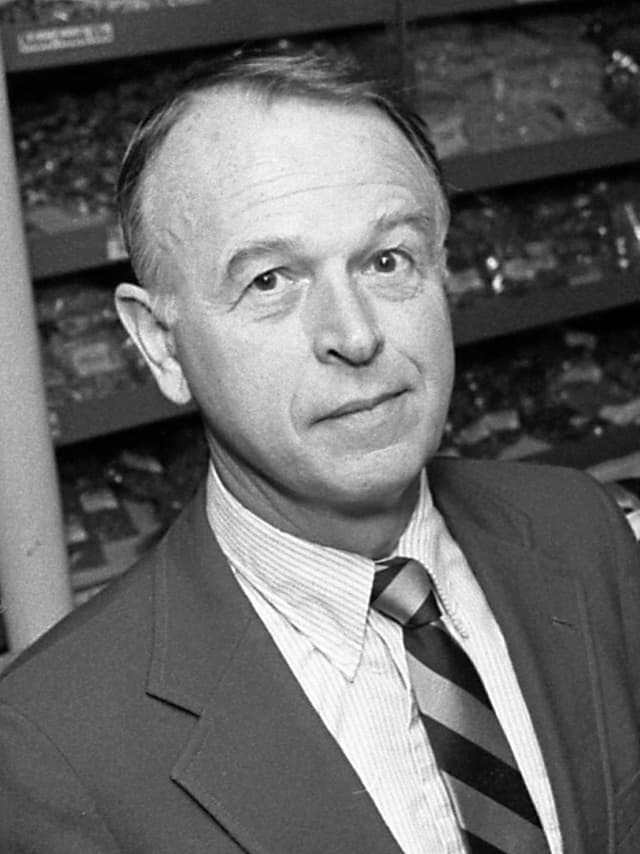
Joe Coulombe
Trader Joe's
A pioneer in the retail industry, Joe Coulombe founded Trader Joe's in 1967, transforming the grocery shopping experience with his innovative approach to business and employee relations. Under his leadership until 1989, Trader Joe's grew from a single store in Pasadena, California, to a beloved chain known for its unique products and exceptional customer service. Coulombe believed in paying high wages as a strategic asset, which reduced turnover and attracted top talent, ultimately enhancing productivity. His vision emphasized that profit should be a byproduct of doing business well, exemplified by his famous quote about wealth creation being tied to excellence rather than a primary goal. By focusing on a reasonable strategy and executing it with tenacity, he set a standard for entrepreneurs and business builders today.
Core Principles
competitive advantage
Design a business with no direct competition by offering products that cannot be price-compared. Create unique, differentiated products rather than competing on commodities.
Joe realized convenience store retailing was inherently commoditized and doomed to margin compression. Instead, he designed Trader Joe's around proprietary and private-label products that couldn't be compared to competitors. This meant Costco-like reduced SKUs, all owned or exclusive products.
“The answer was to design a store that has no competition. That's why Mac the Knife should not carry any SKU in which it was not outstanding.”
Build differentiation through product knowledge superiority. Grocers historically know nothing about what they sell, creating an advantage for those who do.
When offered extra-large AA eggs at the same cost as large eggs, Joe realized he could offer 12 percent more product for the same price in a way competitors couldn't match. This insight about discontinuity and supply constraints became the blueprint for Trader Joe's entire merchandising philosophy.
“The buyers at supermarket chains knew nothing about what they sold, and they don't want to know. Our first product knowledge breakthrough was extra large eggs.”
culture
Conduct employee interviews at a level above the immediate supervisor to identify and address grievances directly. This reduces unionization pressure and improves retention.
Every full-time employee at Trader Joe's received a semi-annual interview with their manager's superior, not their direct boss. This created a safety valve for complaints and prevented the buildup of resentments that drive unionization. Joe considered this practice nearly as important as wages.
“Each employee was interviewed by the manager's superior. The principal purpose was to vent grievances and address them. This program was as important as pay in keeping employees with us.”
customer obsession
Identify underserved affluent niches rather than competing on price and volume. Education, travel, and demographics reveal where demand exceeds supply.
Joe observed through Scientific American and Wall Street Journal that college attendance had jumped from 2 percent in 1932 to 60 percent by 1964, and that international travel would expand due to the Boeing 747. He recognized an emerging group of well-educated, middle-class consumers seeking differentiation from mass culture.
“I felt this newly educated group that was slowly emerging would be dissatisfied with mass culture. They would want something different.”
hiring
Pay high wages as a strategic asset, not a cost. Superior compensation reduces expensive turnover, attracts better talent, and enables higher productivity that pays for itself.
Joe maintained a high wage policy from Pronto Markets through Trader Joe's. During 26 years of operation, he ensured consistent profitability while keeping turnover low through generous pay. He combined this with semi-annual interviews conducted by managers' superiors to address grievances before they festered.
“Turnover is the most expensive form of labor expense. Good people pay for their extra productivity. You cannot afford to have cheap employees.”
Understand that left-handed people (and those with alternative perspectives) see the world differently, sometimes profitably. Hire for unconventional thinking, not just credentials.
Joe was left-handed and came to believe this fundamental trait shaped how people approached problems. He deliberately hired left-handers, creating what critics called a 'cabal of left handers at Trader Joe's.' His point: forced to navigate a right-handed world, left-handers develop different problem-solving approaches.
“I think handedness is the most important thing one can know about a person. Dyslexia lurks in the brain of every left-hander, which means we see the world differently, sometimes profitably.”
leadership
Run the business as a sole decision-maker rather than through committees. This enables rapid course correction and accountability.
Joe explicitly rejected management by committee, calling it a path to slow decision-making. However, he referenced Pierre Montaud's approach as a conductor, not issuing directives but performing in concert with the orchestra. This balance of clarity with collaboration enabled decisive action.
“I called the shots. I rejected management by committee. I think my regime was somewhat short of despotic.”
To sell a vision or plan to stakeholders, you must become a skilled communicator. Plans of action and programs of collaboration require persuasion, not just execution.
Drawing from Jose Ortega's philosophy, Joe recognized that before a business can act, it must align all stakeholders around a common purpose. He borrowed from General Patton the insight that the greatest danger is not enemies learning your plans but your own troops not understanding them.
“Most of my career has been spent selling plans of action and programs of collaboration. If you want to know what differentiates me from most managers, that's it.”
marketing
Use informative advertising that educates rather than manipulates. The more relevant information you provide to interested customers, the more they will buy.
Joe created the Fearless Flyer, borrowing David Ogilvy and Claude Hopkins' insight that detailed, educational copy outperforms brief ads. The Flyer grew to 20+ pages, with customers keeping three-ring binders of issues. This created a medium that educated whether customers shopped or not.
“We assumed our readers had a thirst for knowledge. This was 180 degrees opposite from supermarket ads. We emphasized informative advertising.”
Cultivate a cult of passionate, loyal customers by keeping implicit promises over long periods. Word-of-mouth from true believers is the most effective advertising.
Trader Joe's attracted a cult following of overeducated, underpaid customers who felt the store was made for them. Joe deliberately designed every element to reinforce this identity. Long-term cult status requires consistent delivery, which becomes harder as companies scale.
“Trader Joe's became a cult of the overeducated and underpaid, partly because we deliberately tried to make it a cult. Word of mouth is the most effective advertising of all.”
mindset
Learn from books and apply ideas from seemingly unrelated fields. An entrepreneur's personal curriculum becomes their competitive advantage.
Joe drew management insights from The Guns of August (military history), The Revolt of the Masses (philosophy), David Ogilvy (advertising), and Kobe Bryant (sports). He started each chapter with a relevant quote and demonstrated how ideas from one domain solved problems in another.
“I'm constantly reading books and taking ideas and applying them to my business. Entrepreneurs write better books than writers do because they don't bury the lead.”
Build on the innovations of your predecessors rather than dismissing them. The best founders and investors study history and honor those who came before.
Joe repeatedly referenced Sol Price as an influence and inspiration. He studied retail history, read Ogilvy and Hopkins, and freely acknowledged his intellectual debts. He saw this as the mark of serious entrepreneurs, not weakness.
“All the best founders are historians. They don't talk shit about the people that came before them. They admire them.”
View problems not as failures but as the fundamental material of business. Success comes from creative, profitable problem-solving, not problem elimination.
Joe maintained an entire chapter on 'Hairballs,' the random operational problems that all businesses face. Rather than viewing these negatively, he saw them as the core work of entrepreneurship. Businesses that effectively solve unexpected problems outcompete those that don't.
“A business person who complains about problems doesn't understand where his bread is coming from.”
Reject the 'exit strategy' mindset. A business should be viewed as a life's work to operate, not an asset to be cast off. When you must sell, you lose control of your destiny.
Joe never planned to sell Trader Joe's. His original exit strategy was to work in the business as long as able. Even after the sale, he planned to remain operational. When the new German ownership brought in a liaison, Dieter, who eventually quit, Joe lost the autonomy he'd negotiated for.
“I detest the term exit strategy. A business is not something one builds and casts off. There is an emotional part to business, not just financial.”
operations
Seize opportunistic buys when they deliver customer value, even if temporary. Odd-lot inventory from supplier failures or overstock creates unique value propositions.
When a prune juice company discontinued an odd-shaped container, Joe bought the leftover glass inventory at a steep discount and supplied it to his apple juice vendor, creating substantial retail savings. This discontinuity-driven buying kept product selection fresh and offered unexpected deals.
“The buying from Trader Joe's was as opportunistic as in wine. Some of our great values in fruit juice were generated by getting glass containers for cheap.”
Define your core job clearly and stick to it. For retailers, the fundamental job is to buy goods whole and cut them into pieces for consumers.
Joe traced 'retail' to the medieval French verb 'retailler' meaning to cut into pieces. He used this definition to drive operational decisions: eliminate middlemen (outside salespeople), reduce SKUs ruthlessly, control the supply chain end-to-end, and own the customer relationship entirely.
“The fundamental job of a retailer is to buy goods whole, cut them into pieces and sell the pieces to the ultimate consumers. This is the most important mental construct I can impart to those wanting to enter retailing.”
Reduce SKU count drastically and carry depth only in categories that justify it. Remove all outside sales representatives and control every product decision internally.
Trader Joe's reduced from 10,000 available SKUs (3,000 stocked weekly) down to 1,100-1,500, all delivered through central distribution with zero buying discretion at store level. This allowed high-volume turnover, simpler operations, and focus on quality over variety.
“Each SKU had to justify itself. No fixtures. No whole lines of products. Depth of assortment is of no interest.”
resilience
Consider both risks of action and inaction when making major decisions. Fear-driven decision-making in high-stakes moments often proves regrettable.
Joe sold Trader Joe's in 1989 driven by fears of estate taxes, capital gains rates, and economic uncertainty rather than business fundamentals. He later regretted this deeply, having underweighted the cost of losing control and autonomy. He could have relied on his knowledge of Aristotle's golden mean (nothing to excess).
“Frequently people ask me why I sold. Let me put it this way: I ran Bernie McDonald's risk calculus. What do I risk if I sell? What do I risk if I don't?”
strategy
Study the history of your industry to avoid repeating fatal mistakes. Most failures follow predictable patterns that can be anticipated.
Joe studied retail history and observed that most bankruptcies stemmed from overexpansion and taking on irreversible lease commitments. By designing Trader Joe's around high-volume, capital-efficient stores with strong real estate discipline, he avoided the trap.
“If you study the history of your industry, you can avoid being stupid.”
Understand regulations governing your business as deeply as you understand your products. Regulatory loopholes and grandfather privileges create competitive advantages.
Joe purchased a 1933-vintage wine license for $10,000 instead of a new one for $300 because the old license granted grandfather privileges for wine tastings and wholesale distribution. He extended this principle to using eight separate corporations to navigate tax and wholesale laws.
“A close reading of the regulations showed that a retailer could own a master's wine grower license. New ones didn't have the same grandfather privileges of the 1933 license.”
Adopt a reasonable strategy and execute it with tenacity rather than waiting for an optimal strategy. In non-convex problems with multiple good solutions, moving forward beats endless deliberation.
Joe drew this insight from reading Barbara Tuchman's The Guns of August about World War One. When facing financial pressure and an existential threat from 7-Eleven, he realized he didn't need the perfect plan, just a workable one he could commit to. This conviction became foundational to his decision-making throughout his career.
“If you adopt a reasonable strategy as opposed to waiting for an optimal strategy and stick with it, you'll probably succeed. Tenacity is as important as brilliance.”
Make absolutely no loss leaders. Require that every SKU must be outstanding on either price or uniqueness AND profitable at that price.
Unlike traditional groceries that loss-lead on milk or coffee to attract customers, Trader Joe's refused to sell anything at a loss. This required discipline in product selection but enabled consistent profitability and simpler operations.
“Above all, we would not carry an item unless we could be outstanding in terms of price and make a profit at that price.”
Distinguish between easily reversible and irreversible decisions. Reserve absolute control for major, hard-to-reverse choices like real estate, while delegating reversible ones.
Joe learned early in his career that 15-year leases were the least reversible decisions he could make. He maintained personal control over all real estate decisions while allowing flexibility in other areas. This principle echoes Jeff Bezos' one-way vs. two-way door framework.
“There are two kinds of decisions: the ones that are easily reversible and the ones that aren't. 15-year leases are the least reversible decisions you can make. That's why I kept absolute control of real estate decisions.”
Frameworks
Non-Convex Problem Solving
In problems with multiple good but not ideal solutions, classical search techniques might wrongly identify a suboptimal answer as best. Accept a reasonable, workable solution and execute with tenacity rather than delaying for optimization. This applies to strategy, product development, and operational decisions where perfection is impossible.
Use case: Strategic decision-making under uncertainty, business model design, operational trade-offs
Discontinuity-Driven Merchandising
Rather than stocking full lines of national brands at competitive prices, identify supply discontinuities and market gaps that competitors cannot easily fill. Build the entire merchandising strategy around unique products, odd-lot opportunities, and proprietary sourcing that competitors cannot replicate through price competition.
Use case: Product selection, vendor negotiations, competitive differentiation in commoditized markets
The Golden Mean (Nothing to Excess)
Drawn from Aristotle and Hellenistic philosophy (sophrosyne), this framework asks when enough is enough. Applied to wealth accumulation, growth targets, and ambition, it prevents destructive overextension. Know your true needs and satisfaction level rather than maximizing every variable.
Use case: Exit decisions, growth strategy, work-life balance, personal finance
Reversibility Matrix
Classify decisions into two categories: easily reversible and nearly irreversible. Maintain absolute control over irreversible decisions (real estate, core vendor relationships, brand identity). Delegate or move quickly on reversible decisions. This prevents fatal strategic mistakes while enabling agility.
Use case: Resource allocation, delegation, real estate and lease decisions, capital expenditures
The Retail Job Definition
Trace the word 'retail' to its etymological root: to cut into pieces. The fundamental retail job is buying goods whole and cutting them into pieces for consumers. Use this definition to drive every operational decision: eliminate middlemen, control supply, reduce SKU count, own customer relationships. This clarity prevents scope creep.
Use case: Organizational design, supply chain decisions, vendor relationships, operational scope definition
Plans of Action and Programs of Collaboration
Drawing from Jose Ortega y Gasset, view your business as a plan of action and program of collaboration. The job of leadership is selling this plan to every stakeholder: investors, employees, vendors, landlords, customers. Misalignment on the plan causes failure.
Use case: Company formation, stakeholder communication, change management, vision clarity
Cult-Building Retail Strategy
Target an underserved demographic (overeducated, underpaid, independent-minded) and design every element of the business to feel made for them. Keep implicit promises consistently. Build word-of-mouth through genuine fit rather than marketing spend. Recognize that scale threatens cult status and choose accordingly.
Use case: Niche positioning, brand building, community engagement, growth limitation
Informative vs. Manipulative Advertising
Instead of brief promotional copy designed to manipulate, create detailed, educational content that provides real value whether customers buy or not. Borrowed from David Ogilvy and Claude Hopkins, the principle is that more information to interested audiences increases sales AND customer satisfaction.
Use case: Content marketing, customer communication, brand building, retention
Regulatory Arbitrage
Read regulations governing your business as thoroughly as you read industry reports. Identify grandfather privileges, licensing loopholes, and tax structures that create competitive advantages. Use regulatory complexity to build defensibility that competitors won't pursue.
Use case: Licensing strategy, legal structure, tax optimization, competitive advantage through compliance
Risk Calculus for Major Decisions
When facing a major decision, ask two parallel questions: What do I risk if I say yes? What do I risk if I say no? Then compare those risk profiles. Often fear causes people to weigh inaction risks too lightly and action risks too heavily, leading to suboptimal choices made under emotional pressure.
Use case: Exit decisions, major pivots, capital investments, partnership choices
Stories
In 1965, Merritt Addison Jr. called Joe to a bar meeting to share devastating news: he had sold his milk company to Southland Corporation (7-Eleven's parent), and 7-Eleven was entering California. Joe realized Pronto Markets could not compete with a company a thousand times wealthier. Over that weekend, he secluded himself with his family at Lake Arrowhead cabin to rethink his entire business model.
Lesson: Existential threats force transformational thinking. Rather than trying to beat Southland at their own game, Joe pivoted to a completely different model (Trader Joe's), turning crisis into opportunity.
To buy out Pronto Markets, Joe had to personally guarantee a bank loan. He sold his house (equity $7,000), borrowed $2,000 from his grandmother and $5,000 from his father, and used his wife's teaching savings ($4,000). The banker, Tom Dean, approved the loan based on one reasoning: Rexall was on the leases and wouldn't let Joe go bankrupt.
Lesson: Personal commitment and understanding of your stakeholders' incentives can enable financing when pure financials look weak. Joe's willingness to lose everything signaled conviction.
Joe noticed an egg supplier had excess inventory of extra-large AA eggs and offered them at the same cost as regular large eggs. Joe realized customers would save 12 percent on their total for the same price, while supermarkets couldn't follow because the supply of extra-large eggs was limited. This single insight became the foundation for Trader Joe's merchandising strategy.
Lesson: Superior product knowledge reveals discontinuities that competitors cannot see. By understanding supply constraints, Joe found an edge that couldn't be replicated through price competition.
Reading Scientific American in 1965, Joe learned that college attendance had jumped from 2 percent in 1932 to 60 percent by 1964 (thanks to the GI Bill). The same month, the Wall Street Journal reported the Boeing 747 would slash international travel costs. Joe connected these dots: an emerging class of well-educated, well-traveled people would want products outside of mass-culture offerings.
Lesson: Demographic shifts and technological changes create niche opportunities. By reading broadly and connecting distant ideas, entrepreneurs identify emerging market needs before competitors notice.
Joe purchased a wine license issued in 1933 for $10,000 instead of a new license for $300 because the older license carried grandfather privileges: the right to hold wine tastings and wholesale wine legally. These privileges made the old license far more valuable and enabled Trader Joe's to become a major wine retailer.
Lesson: Close reading of regulations reveals hidden value and competitive advantages. Regulatory complexity that competitors ignore can become your moat.
Joe studied Kobe Bryant's approach to the referee handbook: he learned where referees' viewing zones didn't overlap and exploited those dead zones for minor violations. Joe applied the same principle to his regulations, reading every detail to find advantages (licensing, tax structure, wholesale privileges).
Lesson: Deep knowledge of your operational constraints and rules reveals game-playing opportunities. Excellence often comes from understanding the fine print better than anyone else.
Joe designed the Fearless Flyer as a hybrid newsletter, catalog, and comic book filled with detailed product information, tasting notes, and stories. Customers saved three-ring binders of issues. Despite growing to 20+ pages, the Flyer became Trader Joe's primary marketing tool, validating Hopkins and Ogilvy's principle that the more you tell, the more you sell.
Lesson: Informative advertising that educates builds loyalty and effectiveness simultaneously. Provide genuine value whether or not customers buy, and they will reward you with trust and patronage.
Joe hired left-handed people disproportionately (even engineering interviews to see handedness). Critics joked about his cabal of left-handers. His reasoning: left-handers navigate a right-handed world, developing alternative problem-solving approaches. He believed this different lens was valuable in business.
Lesson: Hire for different perspectives and unconventional thinking, not credentials. Differences in worldview drive innovation.
After 26 years of building Trader Joe's, Joe sold the company in 1989. Driven by fears of estate taxes, capital gains rates, and economic uncertainty, he didn't realize he was sacrificing control for security he didn't need. Within six years, the new German owners' liaison Dieter quit, leaving Joe answering to new management he didn't choose. He left the company and deeply regretted the sale.
Lesson: Fear-driven decisions on major life transitions often prove regrettable. Understand your true needs (using the golden mean) before trading your life's work for hypothetical protection.
Notable Quotes
“The general theme in winning corporations is a view of profit and wealth creation as inevitable byproducts of doing other things well. Money is a useful yardstick for measuring quantitative performance and profit and an obligation to investors, but making money as an end in and itself ranks low.”
From The Winning Performance. Joe's foundational belief that purpose-driven business generates better returns than profit-focused business.
“If you adopt a reasonable strategy as opposed to waiting for an optimal strategy and stick with it, you'll probably succeed. Tenacity is as important as brilliance.”
Drawn from The Guns of August. This principle guided his decision-making throughout his career.
“Turnover is the most expensive form of labor expense. Good people pay for their extra productivity. You cannot afford to have cheap employees.”
Core principle justifying Trader Joe's high wage policy and low turnover.
“15-year leases are the least reversible decisions you can make. That's why I kept absolute control of real estate decisions.”
Illustrating the principle of distinguishing reversible from irreversible decisions.
“The buyers at supermarket chains knew nothing about what they sold, and they don't want to know. Our first product knowledge breakthrough was extra large eggs.”
Explaining how product knowledge became Trader Joe's competitive moat.
“I felt this newly educated group that was slowly emerging would be dissatisfied with mass culture. They would want something different.”
His insight into the target demographic for Trader Joe's based on reading about demographic trends.
“The fundamental job of a retailer is to buy goods whole, cut them into pieces and sell the pieces to the ultimate consumers. This is the most important mental construct I can impart to those wanting to enter retailing.”
Defining the core job of retail to prevent scope creep and organizational confusion.
“Each SKU had to justify itself. No fixtures. No whole lines of products. Depth of assortment is of no interest.”
Describing the operational discipline of Trader Joe's product selection in the Mac the Knife phase.
“We assumed our readers had a thirst for knowledge. This was 180 degrees opposite from supermarket ads. We emphasized informative advertising.”
Explaining the philosophy behind the Fearless Flyer.
“Trader Joe's became a cult of the overeducated and underpaid, partly because we deliberately tried to make it a cult. Word of mouth is the most effective advertising of all.”
Describing the cult-building strategy as intentional rather than accidental.
Frequently Asked Questions
What are Joe Coulombe's key business principles?▼
Joe Coulombe's core principles include: Design a business with no direct competition by offering products that cannot be price-compared. Create unique, differentiated products rather than competing on commodities.. Build differentiation through product knowledge superiority. Grocers historically know nothing about what they sell, creating an advantage for those who do.. Conduct employee interviews at a level above the immediate supervisor to identify and address grievances directly. This reduces unionization pressure and improves retention.. Founder Almanac has cataloged 24 total principles from Joe's career.
What can entrepreneurs learn from Joe Coulombe?▼
Key lessons from Joe Coulombe include: Existential threats force transformational thinking. Rather than trying to beat Southland at their own game, Joe pivoted to a completely different model (Trader Joe's), turning crisis into opportunity.. Explore 9 stories and 10 frameworks from Joe's experience.
What is Joe Coulombe known for in business?▼
A pioneer in the retail industry, Joe Coulombe founded Trader Joe's in 1967, transforming the grocery shopping experience with his innovative approach to business and employee relations. Under his leadership until 1989, Trader Joe's grew from a single store in Pasadena, California, to a beloved chain known for its unique products and exceptional customer service. Coulombe believed in paying high wages as a strategic asset, which reduced turnover and attracted top talent, ultimately enhancing productivity. His vision emphasized that profit should be a byproduct of doing business well, exemplified by his famous quote about wealth creation being tied to excellence rather than a primary goal. By focusing on a reasonable strategy and executing it with tenacity, he set a standard for entrepreneurs and business builders today.
More Retail Founders


Want Joe's advice on your business?
Our AI has studied Joe Coulombe's biography, principles, and decision-making frameworks. Ask any business question.
Start a conversation