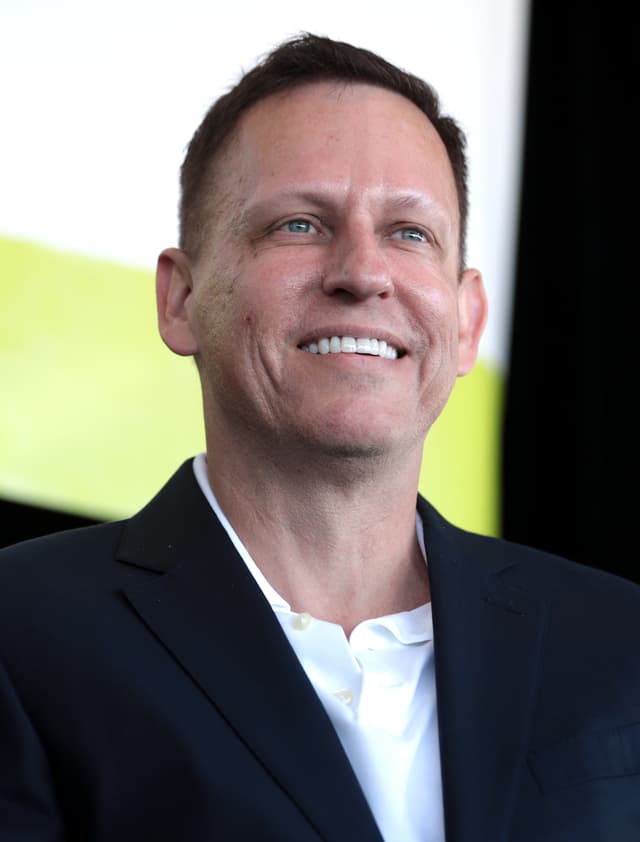
Peter Thiel
PayPal
A prominent figure in the venture capital industry, Peter Thiel co-founded PayPal, which revolutionized online payments and was sold to eBay for $1.5 billion in stock in 2002. Known for his contrarian thinking, Thiel challenges conventional wisdom by asking, "What important truth do very few people agree with you on?" This mindset has allowed him to identify opportunities that others overlook, such as investing early in Facebook when many dismissed its potential. Thiel's strategic approach emphasizes the importance of long-term planning, advocating for positioning oneself to be the last standing in a competitive landscape, which resonates with entrepreneurs today as they navigate the complexities of building successful ventures. His experiences, including a notable legal battle against Gawker, underscore the significance of foresight and preparation in both business and personal endeavors.
Core Principles
competitive advantage
Develop information asymmetry. Success comes from knowing something about a situation that others don't. An edge only exists when you have knowledge or insight competitors lack.
When making investments, Thiel asks what he knows that other investors don't. This asymmetric information is what allows ventures to dominate markets rather than merely compete in them.
“What do I know about this company that other investors don't know? In other words, do we have an edge?”
culture
The best startups resemble cults in fanaticism, but about something correct. People are fanatically right about something those outside have missed.
Unlike actual cults which are fanatically wrong, successful startups unite around a secret truth that the outside world has not yet recognized. This creates the extreme alignment and focus needed for breakthrough companies.
“The best startups might be considered slightly less extreme kinds of cults. The biggest difference is that cults tend to be fanatically wrong about something important. People at a successful startup are fanatically right about something those outside have missed.”
customer obsession
Privacy creates space for weirdos and unconventional thinkers to operate. Progress comes from people comfortable enough to have strange ideas without social shame. Protecting this space is crucial.
Thiel believed deeply that privacy allows individuals to develop counterintuitive ideas without social pressure to conform. He venerated privacy not for its own sake but because it enables the kind of thinking that produces progress.
“He venerated privacy in creating space for weirdos and the politically incorrect to do what they do because he believed that's where the progress came from”
focus
Focus on executing a few critical things correctly rather than trying to manage probabilistic chains of many steps. Complex Rube Goldberg approaches fail when any link breaks.
Mr. A convinced Thiel that rather than viewing the conspiracy as a statistical concatenation of probabilities where anything could break, they should identify the few key execution points that mattered most.
“If you think of what you're doing too probabilistically, where you have all these different steps and there's a chance that all these steps fail, then the conspiracy is very complicated... What Mr. A convinced me of in 2011 was that this is not a statistical concatenation of probabilities. It was that if we simply executed on a few of these things correctly, you could win”
Adopt definitive vision with firm convictions rather than pursuing many-sided mediocrity. Determine the one best thing to do and then do it.
Steve Jobs created Apple's multi-decade plans through careful planning, not focus groups. Great founders reject diversification and go all in on building something substantive. A definitive person strives to be great at something specific rather than good at many things.
“Instead of pursuing many-sided mediocrity and calling it well-roundedness, a definitive person determines the one best thing to do and then does it.”
Focus on finding the few companies that can become overwhelmingly valuable. Diversification in venture capital (and career choice) causes you to miss those rare companies in the first place.
Most venture returns follow a power law distribution where a small handful of companies radically outperform all others. If you diversify, you'll spend time on the second, third, or fourth most important thing instead of the one that truly matters.
“If you focus on diversification instead of single-minded pursuit of the very few companies that can become overwhelmingly valuable, you'll miss those rare companies in the first place.”
hiring
Hire people who will challenge you and the company's direction. Bracing honesty and willingness to say 'that idea is dumb' is more valuable than agreement.
Peter Thiel overruled the entire team to hire David Sachs, who had walked into his interview proclaiming PayPal's core product a dumb idea. Thiel valued this kind of honesty and candor. He knew that A-level people surround themselves with people who will tell them hard truths.
“Few people would come into an interview guns blazing against their prospective employer's flagship product. Thiel valued bracing honesty, and he trusted that Sachs would speak candidly.”
Recruiting is a core competency and should never be outsourced. The success of your company depends on the first people you recruit.
Talented people have many options and do not need to work for you. Generic pitches fail. You must offer something specific: the opportunity to do irreplaceable work on a unique problem alongside great people, rather than competing on perks.
“Recruiting is a core competency.”
A startup messed up at its foundation cannot be fixed. Bad decisions made early about partners and key people are nearly impossible to correct without a crisis.
Founder relationships are like marriages, and founder conflict is as ugly as divorce. The company becomes the victim when founders clash. Your first and most crucial decision is whom to start it with.
“Thiel's Law: a startup messed up at its foundation cannot be fixed.”
Choose co-founders who share a prehistory with you. Founders should know each other well before starting together and have demonstrated ability to work together.
When evaluating startups to invest in, Thiel studies founding teams carefully. Technical skills matter, but how well founders know each other and work together matters equally. If you cannot count durable relationships among the fruits of your time at work, you have not invested your time well.
“Founders should share a prehistory before they start a company together.”
innovation
Secrets give you an edge. Every correct answer to the business question 'What valuable company is nobody building?' is necessarily a secret, something important and unknown.
Contrarian thinking only makes sense if the world still has secrets left to discover. If something hard seems impossible, you'll never try. But great companies are built on open but unsuspected secrets about how the world works.
“If you think something hard is impossible, you never even start to try to achieve it.”
leadership
A startup is a small group of people convinced of a truth that nobody else believes. This applies equally to businesses, conspiracies, or any ambitious project.
The core requirement for any transformative effort is getting a small group aligned around a counterintuitive belief. Thiel, Mr. A, and his attorney formed this nucleus around the belief that Gawker could be challenged.
“A startup is, in Peter's definition, a small group of people that you've convinced of a truth that nobody else believes in”
marketing
Advertising works on everyone, including those who believe they are immune to it. It embeds subtle impressions that drive sales later, not immediate purchases.
In Silicon Valley, technical founders often dismiss advertising as superficial. But advertising works because it shapes perception over time. Anyone who believes they are an exception to advertising's effects is doubly deceived about their own independence of mind.
“Advertising doesn't exist to make you buy a product right away. It exists to embed subtle impressions that will drive sales later.”
mindset
Ask the contrarian question: What important truth do very few people agree with you on? This question reveals opportunities that others overlook because they accept conventional wisdom.
Peter Thiel famously uses this question in interviews and conversations. Holiday applies it to suggest society needs more boldness, less complacency, and more people willing to question the status quo rather than accept it passively.
“What important truth do very few people agree with you on?”
Recognize that we live in a world where people underestimate what is possible. Many dismiss ambitious plans as impossible before attempting them, creating opportunity for those willing to try.
When Peter Thiel began planning to challenge Gawker, nearly everyone told him it was impossible. This pessimism about possibility is pervasive in culture but creates openings for those with higher agency.
“We live in a world where people don't think conspiracies are possible. We tend to denounce conspiracy theories because we are skeptical of privileged claims to knowledge and of strong claims of human agency”
Embody contradiction in your thinking. Hold multiple antagonistic ideas simultaneously without choosing between them. This allows you to see what others miss by considering problems from many perspectives.
Thiel's default intellectual state is to consider an issue from opposing viewpoints before settling on his position. He often begins with 'one view is...' before presenting the opposite perspective. This contradictory thinking enables him to see non-obvious solutions.
“Peter's default state is to embody contradiction. If you were able to open his skull, you would see a number of Mexican standoffs between powerful antagonistic ideas you wouldn't think could be safely housed in the same brain”
Advertising works even on people who believe they're immune to it. Anyone who can't acknowledge advertising's effect on themselves is doubly deceived about their own independence of mind.
This principle from Zero to One explains why Senra removed ads from the podcast. True intellectual honesty requires admitting that ideas we consume shape us, not accepting a false narrative of complete autonomy.
“It works on nerds and it works on you. You may think that you're an exception, that your preferences are authentic, and advertising only works on other people. Anyone who can't acknowledge its likely effect on himself is doubly deceived”
Ask the contrarian question to unlock future insight: What important truth do very few people agree with you on? Brilliant thinking is rare, but the courage to express unpopular truths is even rarer.
Thiel uses this question to hire and identify founders. A good answer takes the form: Most people believe X, but the truth is the opposite. This reveals how someone sees the present differently, which is the closest we can get to seeing the future.
“What important truth do very few people agree with you on? Brilliant thinking is rare, but courage is an even shorter supply than genius.”
operations
Assign each person responsibility for doing just one thing. Make that one thing their unique contribution and evaluate them only on that metric.
When Thiel was CEO of PayPal, he assigned each employee a single responsibility. This simplified management while reducing internal conflict that usually arises from competing responsibilities. It forced the entire organization to focus on solving A-plus problems rather than procrastinating on difficult challenges.
“The best thing I did as a manager at PayPal was to make every person in the company responsible for doing just one thing.”
sales
Superior sales and distribution by itself can create a monopoly even with no product differentiation. The converse is not true: no amount of product superiority guarantees success without distribution.
Most entrepreneurs underestimate distribution because they assume a great product sells itself. But distribution is essential to product design. If you invented something new but no effective way to sell it, you have a bad business regardless of product quality.
“Superior sales and distribution by itself can create a monopoly even with no product differentiation. The converse is not true.”
Distribution follows a power law. One distribution method is likely to be far more powerful than all others for your business. Most businesses fail at distribution.
The kitchen sink approach, employing salespeople, placing ads, and adding viral features as an afterthought does not work. Most companies get zero distribution channels working. If you can get just one channel to work, you have a great business.
“One of these methods is likely to be far more powerful than every other for any given business. If you can get just one distribution channel to work, you have a great business.”
The most common reason for startup failure is poor sales, not a bad product. Everything requires to be sold, and everybody sells, whether you are an employee, founder, or investor.
This challenges the engineering mindset that great products sell themselves. In reality, distribution and sales are fundamental business activities regardless of role.
“Poor sales rather than bad product is the most common cause of failure.”
strategy
Study the end to design the beginning. Rather than being the first to act, position yourself to be the last standing. History shows those who rush ahead without planning suffer worse outcomes.
Thiel's favorite chess player, Jose Raul Capablanca, emphasized understanding endpoints before beginning. Thiel applied this to the Gawker situation by studying their vulnerabilities before moving against them, rather than reacting rashly.
“To begin, you must study the end. You don't want to be the first to act. You want to be the last man standing”
Criticism from those who don't believe in your idea is valuable. If skeptics don't think something is possible, they won't take it seriously or try to stop it until it's too late.
When people warned Thiel that challenging Gawker was impossible, this actually worked in his favor. Gawker underestimated the threat and didn't mount a serious defense because most observers said it couldn't be done.
“That's a good thing. He liked hearing that criticism. We don't really need to worry about those people very much because since they don't think it's possible, they won't take us very seriously, and they will not actually try to stop us until it's too late”
Recognize prehistory in ventures. Most successful companies have a hidden pre-launch phase where ideas develop, resources accumulate, and groundwork is laid before the visible startup emerges.
Thiel's Palantir was registered years before it was formally founded. PayPal's fraud detection insights took years to develop. The visible startup journey is often much shorter than the actual development timeline.
“Thiel calls this the prehistory of a company, of a conspiracy”
Successful people find value in unexpected places by thinking from first principles rather than applying formulas. This contrarian approach reveals opportunities that conventional thinking overlooks.
Thiel observes that the most powerful pattern among successful founders is their ability to see beyond accepted wisdom. Sam Walton found value in rural towns ignored by other retailers, building one of history's greatest fortunes by rejecting conventional retail strategy.
“The single most powerful pattern I have noticed is that successful people find value in unexpected places and they do this by thinking about business from first principles instead of formulas.”
Do not build an undifferentiated commodity business. Aim to create a monopoly by solving a unique problem that no other firm can replicate.
PayPal in 2001 employed fewer people than the restaurants around it but was far more valuable because it was the only email-based payments company in the world. Every business succeeds to the extent it does something others cannot.
“Every business is successful exactly to the extent that it does something others cannot. All happy companies are different. Each one earns a monopoly by solving a unique problem. All failed companies are the same. They failed to escape competition.”
Frameworks
Information Asymmetry Analysis
Success comes from identifying what you know that others don't about a situation. Ask specifically: what information do I have that competitors lack? This creates an 'edge' that allows dominance rather than competition.
Use case: Apply when evaluating investments, market opportunities, or competitive positioning. Helps identify where you have genuine advantage versus where you're competing on commoditized factors.
The Contrarian Question Framework
Ask yourself and your team: 'What important truth do very few people agree with you on?' This question reveals where your deepest insights and opportunities likely exist, since conventional wisdom is usually already priced in.
Use case: Use during strategy sessions, business planning, or when feeling stuck. Helps surface assumptions everyone is making and where real differentiation might exist.
Prehistory Mapping
Most successful ventures have a hidden pre-launch phase where ideas develop and resources accumulate before the visible startup phase. Identify and plan for this hidden phase rather than expecting immediate execution.
Use case: Apply when starting ventures or launching initiatives. Helps set realistic timelines and understand that the public launch date is often far later than when real work began.
Focus on Few Critical Points
Rather than managing probabilistic chains where any step can break, identify the few critical things that must be executed correctly. Simplify by asking: what are the 2-3 things that actually matter here?
Use case: Use for project planning and risk management. Helps allocate resources to the few things that determine success rather than spreading effort across many things.
The Billionaires Breakfast Club
A regular forum of peer founders and thinkers who gather to discuss technology, philosophy, business, and predictions for the future. These small groups create accountability and cross-pollination of ideas without the formality of a company.
Use case: Personal development and idea generation. Use this to maintain intellectual challenge outside your company.
The Contrarian Question
A tool for identifying secrets and future opportunities. Ask: What important truth do very few people agree with you on? A good answer takes the form: Most people believe X, but the truth is the opposite of X. This reveals how someone sees the present differently, which approximates seeing the future. Use it when hiring, setting strategy, or identifying market opportunities.
Use case: Finding competitive advantage, hiring, strategy development, market identification
The Four Characteristics of Durable Monopolies
A framework for evaluating whether your business can sustain monopoly position long-term. Analyze your business across: proprietary technology (hard to replicate), network effects (more valuable as it scales), economies of scale (stronger as it grows), and strong branding. These are not boxes to check but analytical lenses. No business needs all four, but understanding which apply helps you build durability.
Use case: Product development, competitive strategy, long-term planning, investment decisions
Market Sequencing Strategy
A disciplined approach to geographic and market expansion. Start with a small, concentrated market served by few competitors and truly dominate it. Then expand gradually into adjacent, slightly broader markets. This requires resisting the urge to chase large markets immediately. Amazon started with books before expanding to all retail.
Use case: Growth planning, market entry strategy, expansion planning
The One Thing Assignment
An organizational structure where each employee owns exactly one unique responsibility. The founder evaluates them solely on that metric and will not have conversations about other topics. This simplifies management, reduces internal conflict over competing responsibilities, and forces the organization to focus on solving A-plus problems rather than procrastinating on them.
Use case: Organizational design, role clarity, focus management, conflict reduction
The Founder Prehistory Principle
A hiring and co-founder selection framework based on shared history. Prospective co-founders or key early hires should have worked together before or have deep knowledge of each other's work style. The decision to work together should not be made in isolation. This principle reduces the risk of founder conflict and ensures alignment.
Use case: Hiring, co-founder selection, team building
Stories
Peter Thiel reads Machiavelli's Discourses on Livy, particularly the chapter on conspiracies, years before anyone wrongs him. When Gawker outs him and mocks him in 2007, the seed planted by his reading years earlier provides the conceptual framework for response rather than acceptance.
Lesson: Ideas planted through reading can lie dormant until they're needed, then suddenly activate to guide behavior. This demonstrates the power of absorbing ideas before you need them, so they shape thinking when crises arrive.
Peter Thiel invested in a smart calendar company, a saturated market with 200 competitors. It was a failure, but Thiel studied the failure deeply. He learned the lesson: minimize competition. This insight, learned in failure, would become central to PayPal's strategy and his later philosophy that 'competition is for losers.'
Lesson: Failures are teachers if you study them carefully. Extract the principle, not just the negative outcome.
David Sachs walked into his interview at Confinity and immediately attacked the company's flagship product (Palm Pilot money beaming) as a dumb idea. He was right: there were only 5 million Palm Pilot users, and the use case for beaming money was unclear. The entire team objected to hiring him, but Peter Thiel overruled them because he valued Sachs' bracing honesty.
Lesson: Hire people who will tell you hard truths. Their disagreement is more valuable than consensus from people who lack conviction.
During the dot-com bubble in 1999, a Korean investment firm wired PayPal $5 million without negotiating a deal or signing documents. When Thiel tried to return the money, they would not even tell him where to send it. This was emblematic of the era's irrational behavior.
Lesson: Periods of collective mania corrupt judgment at scale. Use customer impact as an anchor to reality when everyone around you is behaving irrationally. Ask: Does this actually help our customers?
In 1876, Mark Twain wrote about Tom Sawyer convincing neighbors to whitewash a fence, then paying them for the privilege of doing his chores. This demonstrated masterful hidden sales, where the customer does not realize they are being sold.
Lesson: The best salesmanship is invisible. The most effective distribution and marketing strategies do not announce themselves as sales pitches. Great founders understand that superior sales can create monopolies even without product differentiation.
When Yahoo offered Facebook $1 billion in 2006, Mark Zuckerberg walked into the board meeting and immediately dismissed it, saying it should only take 10 minutes because they were obviously not selling. Zuckerberg saw where he could take the company, while Yahoo could not.
Lesson: A founder with a definitive vision and robust plans understands the true value of their company better than outside acquirers. Any offer from someone without your vision will be wrong, either too low or too high. Only sell if you have no concrete vision for the future.
When Thiel was CEO of PayPal, he assigned each employee exactly one responsibility and would not discuss anything else with them. This constraint forced difficult choices about what truly mattered.
Lesson: Clarity about singular focus reduces conflict and forces organizations to solve A-plus problems instead of procrastinating on them. Focus is more powerful than flexibility when building something new.
Notable Quotes
“What important truth do very few people agree with you on?”
Thiel's famous contrarian question that he uses in interviews and dinners. It's designed to surface areas where someone has genuine insight or counterintuitive understanding.
“To begin, you must study the end. You don't want to be the first to act. You want to be the last man standing.”
Quoting chess master Jose Raul Capablanca's philosophy. Thiel applies this to the Gawker situation, studying vulnerabilities before acting rather than responding emotionally.
“Gawker's power in part came from pretending that it was more powerful than it was. Once that power dissolves, it's difficult to remember how that once was the view. But it was the view.”
Thiel's observation that Gawker maintained influence through projection of invulnerability. Once challenged effectively, the previous assumption of untouchability became unbelievable.
“If you think of what you're doing too probabilistically, where you have all these different steps and there's a chance that all these steps fail, then the conspiracy is very complicated. What Mr. A convinced me of was that if we simply executed on a few of these things correctly, you could win.”
Thiel explaining why focusing on a few critical execution points rather than managing complex probability chains is more effective.
“We live in a world where people don't think conspiracies are possible. We tend to denounce conspiracy theories because we are skeptical of privileged claims to knowledge and of strong claims of human agency.”
Thiel's explanation for why most people believe ambitious projects are impossible, creating opportunity for those willing to try.
“The single most powerful pattern I've noticed is that successful people find value in unexpected places, and they do this by thinking about business from first principles instead of formulas.”
Principle that copying formulas fails during paradigm shifts and that success requires rethinking strategy from first principles rather than following existing models.
“Superior sales and distribution by itself can create a monopoly, even with no product differentiation. The converse is not true.”
Why Estée's obsession with sales and distribution mattered more than her competitors. Great sales can win even without superior products, but great products lose without great sales.
“Few people would come into an interview guns blazing against their prospective employer's flagship product. Thiel valued bracing honesty, and he trusted that Sachs would speak candidly.”
Explaining why Thiel overruled the team to hire David Sachs, who had attacked PayPal's core product in his interview.
“Show me a good loser, and I'll show you a loser.”
Expressing his extreme competitiveness and belief that accepting defeat gracefully reflects a lack of conviction.
“The single most powerful pattern I have noticed is that successful people find value in unexpected places and they do this by thinking about business from first principles instead of formulas.”
Explaining why he wrote Zero to One and the core pattern he observed across successful founders and companies
Frequently Asked Questions
What are Peter Thiel's key business principles?▼
Peter Thiel's core principles include: Develop information asymmetry. Success comes from knowing something about a situation that others don't. An edge only exists when you have knowledge or insight competitors lack.. The best startups resemble cults in fanaticism, but about something correct. People are fanatically right about something those outside have missed.. Privacy creates space for weirdos and unconventional thinkers to operate. Progress comes from people comfortable enough to have strange ideas without social shame. Protecting this space is crucial.. Founder Almanac has cataloged 30 total principles from Peter's career.
What can entrepreneurs learn from Peter Thiel?▼
Key lessons from Peter Thiel include: Ideas planted through reading can lie dormant until they're needed, then suddenly activate to guide behavior. This demonstrates the power of absorbing ideas before you need them, so they shape thinking when crises arrive.. Explore 7 stories and 10 frameworks from Peter's experience.
What is Peter Thiel known for in business?▼
A prominent figure in the venture capital industry, Peter Thiel co-founded PayPal, which revolutionized online payments and was sold to eBay for $1.5 billion in stock in 2002. Known for his contrarian thinking, Thiel challenges conventional wisdom by asking, "What important truth do very few people agree with you on?" This mindset has allowed him to identify opportunities that others overlook, such as investing early in Facebook when many dismissed its potential. Thiel's strategic approach emphasizes the importance of long-term planning, advocating for positioning oneself to be the last standing in a competitive landscape, which resonates with entrepreneurs today as they navigate the complexities of building successful ventures. His experiences, including a notable legal battle against Gawker, underscore the significance of foresight and preparation in both business and personal endeavors.
More Venture Capital Founders


Want Peter's advice on your business?
Our AI has studied Peter Thiel's biography, principles, and decision-making frameworks. Ask any business question.
Start a conversation