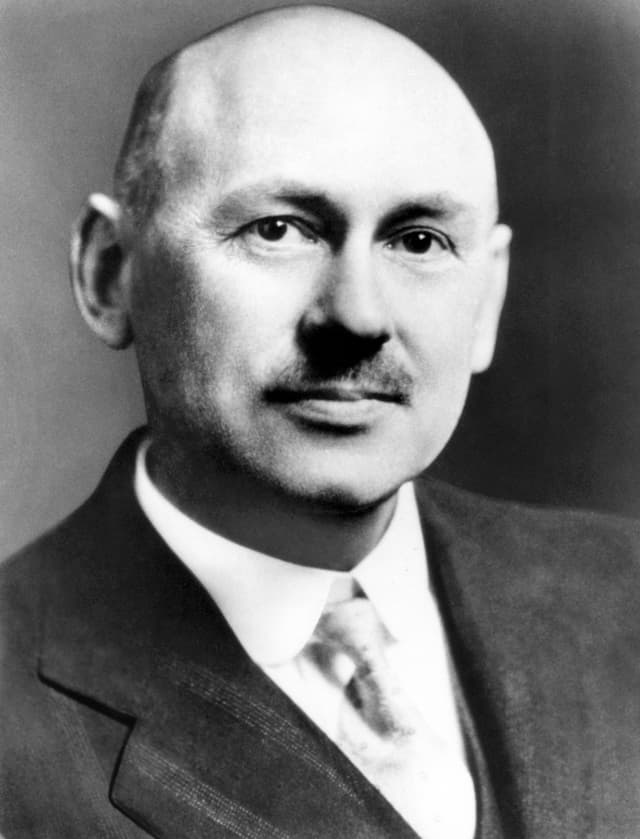
Robert H. Goddard
Clark College (Physics Professor)
A pioneer in aerospace engineering, Robert H. Goddard dedicated his life to realizing the dream of space travel, inspired by a childhood vision of ascending to Mars from the branches of a cherry tree. As a professor at Clark College, he emphasized the importance of committing to one's purpose and systematically addressing knowledge gaps, which ultimately led him to achieve the world’s first successful liquid-fueled rocket launch in 1926. Goddard's innovative spirit and determination resonate with today's entrepreneurs, reminding them that groundbreaking visions often face skepticism before they become accepted realities. His famous assertion, "Every vision is a joke until the first man accomplishes it," underscores the value of perseverance in the pursuit of seemingly impossible goals.
Core Principles
focus
Avoid constant distraction and shifting of priorities, as this fragments resources and delays meaningful progress.
Goddard's worst habit was pursuing multiple design improvements and theoretical investigations simultaneously rather than optimizing toward a single clear milestone. Lindbergh repeatedly urged him to focus on achieving height records to secure funding, but Goddard kept adjusting designs instead.
“Lindbergh had become impatient with Goddard switching layouts instead of focusing on something simple to make a high flight sooner.”
Focus on solving the most immediate fundamental problem first, not problems that may arise later.
Goddard initially obsessed over theoretical concerns about space travel like suspended animation for long journeys. He eventually realized this was premature: he first needed to prove a rocket could reach space. By focusing on first things first, he produced his magnum opus on raising objects to great altitudes.
“It was fruitless to talk about roaming space until he figured out how to get there. For the first time, he had placed first things first.”
hiring
Recruit missionaries, not mercenaries, to your mission: people who believe in the work itself rather than just compensation.
Goddard's team, including Charles Minsher who started as a janitor and lost three fingers in an explosion, continued working on rockets because they believed in the mission. They accepted minimal pay and dangerous conditions because they were passionate about the work.
innovation
History is full of useful ideas from other domains: apply existing knowledge from different fields to solve new problems.
Goddard discovered that making a rocket's head heavier for ballistic stability was based on principles archers had known for millennia with arrows. He synthesized knowledge from existing fields to build rocket innovation.
“History is full of useful ideas.”
Translate theoretical knowledge into working prototypes because demonstration matters more than theory to those controlling resources.
Many inventors arrived at similar rocket conclusions through mathematics and theory. Goddard distinguished himself by actually building and launching a liquid-fuel rocket in 1926, proving the concept worked in practice. This differentiation secured him historical credit as the father of rocketry.
“Goddard proved it on paper and then actually proved it in real life.”
Understand that creating an entirely new field or industry requires working without precedent or available expertise.
In rocketry, there were no experts to hire because the field was brand new. Goddard had to learn by inventing, a situation that actually favored passionate beginners over experienced practitioners from other fields.
“I'm a firm believer that most people who do great things are doing them for the first time.”
leadership
Seek mentors with expertise you lack and collaborate to fill knowledge gaps rather than attempting to master everything yourself.
Early in his career, Goddard sought out older mentors with resources and knowledge he lacked. Despite his reputation for working in isolation, he built relationships with figures like Lindbergh, Guggenheim, and academic colleagues who provided both knowledge and funding.
mindset
Maintain technological optimism based on the belief that what the human mind can conceive, it can eventually achieve.
After reading H.G. Wells, young Goddard developed what the author calls technological optimism: the conviction that if human imagination could conceive of interplanetary travel, the means to accomplish it must be discoverable. This mindset sustained him through decades of ridicule.
“If the human mind could conceive of such things, could it not also figure out a way to do them?”
Recognize when your knowledge gaps exceed your experimental reach and systematically seek education to close them.
As a young experimenter, Goddard realized his experimental reach had exceeded his uneducated grasp. Rather than persisting in ignorance, he enrolled in high school at age 19 to gain formal knowledge needed for his rocket work.
“The best plan for all of us to follow is to leave our researches and investigations until knowledge and experience are attained, after which our work will either be crowned with success or buried once and for all as an impossibility.”
Make two critical life decisions correctly: choosing the right spouse and selecting your life's work, as these determine overall life satisfaction.
Goddard married Esther, who supported his work throughout their 21-year marriage and spent 37 years after his death building his legacy. He found both purpose in rocketry and partnership with a devoted spouse, creating a satisfying life despite never seeing his dream fulfilled.
Find your life's purpose early and commit to it unconditionally, even when others mock you or the goal seems impossible.
At age 17, Goddard climbed a cherry tree and had a vision of reaching Mars. He declared it his life's purpose and celebrated the anniversary of that day every year for the rest of his life. This singular focus drove his entire career in rocketry, even when called a crackpot.
“For existence at last seemed very purposeful.”
operations
Practice extreme resourcefulness when operating with limited capital by reusing materials and wasting nothing.
Goddard and his team operated on tiny budgets throughout his career. When rockets exploded, they salvaged usable parts and incorporated them into the next rocket. This patchwork approach meant his rockets were often assemblies of reclaimed components, yet they achieved unprecedented results.
“He taught them to make do with what they had, fashioning fine instruments out of whatever scraps we could find. They wasted nothing.”
Develop a daily routine that separates execution from reflection and ideation.
Goddard divided his day into two parts: practical work and experiments during the day, then devoted evenings to writing suggestions and ideas. This rhythm of doing and thinking enabled him to iterate systematically over decades.
product
Build projects incrementally without demanding they be perfect or complete at each stage.
Goddard's first liquid rocket flight in 1926 went only 41 feet high and 184 feet away after 27 years of work. Rather than embarrassment, he compared it to the Wright brothers' first flight and continued iterating. Seven years later, his rockets reached 2,000 feet with barely any damage.
resilience
Accept failure as an integral part of invention and maintain emotional equilibrium through inevitable ups and downs.
Goddard worked on powder-based multi-charge rockets for eight to thirteen years before abandoning the approach. Rather than despair, he returned to an earlier idea about liquid propellants he had noted in 1909. Colleagues noted he appeared to take successes and failures with equal calm.
“He appeared to take the ups and downs calmly. My most vivid impression of Goddard was a sense of humor, his ready laugh and his ability to be elated like a youngster over small incidents.”
sales
To secure funding or support, present yourself as a solution to your customer's problem, not as a supplicant seeking approval.
Goddard's inability to sell his work cost him crucial military funding and support. When approaching the military, he spoke about his vision of reaching Mars rather than how rockets could solve their warfare problems. This failure of communication prevented him from securing resources that would have accelerated his work.
“I've never had myself any great talent for selling ideas.”
strategy
Build infrastructure and foundational systems knowing you may not live to see their full application, but they enable future generations.
Goddard knew reaching Mars would take decades beyond his lifetime. He approached his work like building infrastructure for others to build upon, similar to how Bezos views Blue Origin. This long-term orientation allowed him to accept incremental progress without despair.
“How many more years I should be able to work on this problem? I do not know. I hope as long as I live, there can be no thought of finishing for aiming at the stars.”
Frameworks
First Things First Framework
Identify the single most fundamental problem that must be solved before addressing secondary challenges. In Goddard's case, proving a rocket could reach space came before theoretical concerns about long-duration travel or suspended animation. This framework prevents wasted effort on premature optimization.
Use case: When facing a complex, multi-stage problem, use this to sequence work logically and avoid solving problems in the wrong order.
George Clooney Sales Method
Reframe the sales interaction from seeking approval to offering solutions. Recognize that the buyer has a problem (unfilled need), and present yourself as the solution to that specific problem rather than appealing to how talented or worthy you are. This shifts power dynamics in your favor.
Use case: When pitching to investors, customers, or funders, diagnose their problem first and position your work as the solution.
Two Pillars of Life Satisfaction
Make two critical decisions correctly to achieve a satisfying life: choose the right spouse and choose the right work. These two domains determine overall life quality more than any other factors. Poor choices in either domain can undermine success in the other.
Use case: As a personal framework for evaluating whether you're on a path to long-term happiness, not just short-term achievement.
Missionaries vs. Mercenaries Framework
Recruit team members who believe in the mission itself rather than those motivated primarily by compensation. Missionaries will endure hardship, accept low pay, and persist through setbacks because they believe in the work. This matters especially in pioneering or uncertain ventures.
Use case: When building a team for innovative or long-duration projects where resources are limited and motivation must be intrinsic.
Day Divided Into Execution and Reflection
Structure time into two distinct parts: execution work during the day, and systematic reflection, note-taking, and ideation in the evening. This rhythm ensures both action and thoughtful iteration.
Use case: Creating a sustainable daily routine for innovation work that prevents either pure execution without learning or pure theorizing without building.
Stories
At age 17, Goddard climbed a cherry tree and imagined a device that could ascend to Mars. The vision was so powerful that he spent the rest of his life pursuing it. He photographed that tree repeatedly and marked the anniversary each year in his diary as his personal holiday.
Lesson: A clear, vivid vision encountered in youth can organize an entire life's work. Finding your purpose early, even through seemingly small moments, provides direction for decades.
At 26, Goddard was diagnosed with tuberculosis and given two weeks to live. Rather than accept the doctors' prognosis, he devised his own recovery regimen of deep breathing exercises in the freezing winter air, wrapped in blankets. He recovered fully and lived another 19 years.
Lesson: Physical resilience and the willingness to defy expert opinion can overcome seemingly insurmountable obstacles. Self-directed action, even unconventional action, sometimes succeeds where conventional treatment fails.
After his high school graduation, Goddard felt uncertain and discouraged by his lack of accomplishment. He burned his accumulated scientific notes from high school, judging them amateurish. But within two months, his natural drive reasserted itself and he resumed making notes on his ideas.
Lesson: Discouragement and self-doubt are normal even for gifted people, and burning old work can mark a transition point. The key is that internal drive, if allowed to reassert itself, returns to guide you forward.
Charles Minsher, a janitor, asked Goddard for work. Goddard gave him $100 to work with until he earned it. Minsher lost three fingers in a cartridge explosion but continued working. He stayed until Goddard's death and became a distinguished rocketeer in his own right.
Lesson: Great people attract other great people through genuine work and mission. Someone willing to accept dangerous conditions and minimal pay for meaningful work is a missionary, not a mercenary, and these are the people you want on your team.
For eight to thirteen years, Goddard pursued multi-charge powder rockets before accepting the approach would not work. Rather than feel like a failure, he returned to an idea from 1909 about liquid propellants and found success with liquid oxygen and hydrogen.
Lesson: Persistence combined with flexibility is the right balance. Stubbornly abandoning a failed path is not giving up on your vision, it's learning how to achieve it.
Charles Lindbergh repeatedly urged Goddard to focus on achieving height records to secure funding, but Goddard kept tinkering with design improvements instead. Lindbergh lectured him: people don't understand theory, they need to see demonstrations. Goddard continued switching layouts rather than optimizing for the milestone.
Lesson: Even brilliant minds can resist feedback about priority and focus. External pressure to optimize the path to near-term milestones often conflicts with the desire to improve the overall system, but near-term wins unlock resources for long-term vision.
Goddard's first liquid-fuel rocket launch in 1926 flew 41 feet high and 184 feet away in about seven seconds. Rather than downplay it, Goddard noted the Wright brothers' first flight covered only 120 feet in 12 seconds. He framed his milestone properly and continued building.
Lesson: Context matters. Celebrating proportional progress, not absolute distance, maintains motivation. Comparing your early stage to others' early stages, not to their mature state, gives accurate perspective.
Notable Quotes
“Every vision is a joke until the first man accomplishes it. Once realized, it becomes commonplace.”
Responding to the New York Times editorial mocking his idea that rockets could reach the moon, written in 1920. This encapsulates his philosophy about working on ideas others consider impossible.
“For existence at last seemed very purposeful.”
Reflecting on descending from the cherry tree after his vision of reaching Mars at age 17. This moment marked the beginning of his 46-year dedication to rocketry.
“The best plan for all of us to follow is to leave our researches and investigations until knowledge and experience are attained, after which our work will either be crowned with success or buried once and for all as an impossibility.”
Written as a teenager realizing his experimental reach exceeded his formal knowledge. Shows early maturity in recognizing when to pause and gain education before continuing experimentation.
“Anything is possible with the man who makes the best use of every minute of his time.”
Aphorism from Goddard's college diary, reflecting his belief in maximizing productivity and his awareness of life's brevity.
“There are limitless opportunities open to the man who appreciates the fact that his own mind is the sole key that unlocks them.”
Another college diary aphorism emphasizing the power of individual thought and agency.
“It is appalling how short life is and how much there is to do. We have to be sports, take chances and do what we can.”
Reflecting on mortality and the need to act decisively with the limited time available. Expressed awareness of life's brevity from an early age.
“From an economic point of view, the navigation of interplanetary space must be affected to ensure the continuance of the race and if we feel that evolution has through the ages reached its highest point in man the continuation of life and progress must be the highest end and aim of humanity.”
Articulating his rationale for space exploration as species survival and continuance of progress. The host notes these sentiments closely parallel Elon Musk's later philosophy.
“The dream would not down, and inside of two months, I caught myself making notes of further suggestions for even though I reasoned with myself that the thing was impossible, there was something inside me which simply would not stop working.”
Reflecting on his depression after high school and burning his notes. Despite rational doubts, internal drive compelled him to resume his work on reaching Mars.
“I told him there were some things I just couldn't help working on.”
Responding to a doctor's orders that he stop research and live outdoors. Shows his inability to abandon his work despite health warnings.
“The rocket is very human. It can race itself to the very loftiest position solely by the ejection of enormous quantities of hot air.”
Humorous reflection on his own difficulties, suggesting rockets and people share the ability to reach great heights through the expulsion of empty talk.
Frequently Asked Questions
What are Robert H. Goddard's key business principles?▼
Robert H. Goddard's core principles include: Avoid constant distraction and shifting of priorities, as this fragments resources and delays meaningful progress.. Focus on solving the most immediate fundamental problem first, not problems that may arise later.. Recruit missionaries, not mercenaries, to your mission: people who believe in the work itself rather than just compensation.. Founder Almanac has cataloged 17 total principles from Robert's career.
What can entrepreneurs learn from Robert H. Goddard?▼
Key lessons from Robert H. Goddard include: A clear, vivid vision encountered in youth can organize an entire life's work. Finding your purpose early, even through seemingly small moments, provides direction for decades.. Explore 7 stories and 5 frameworks from Robert's experience.
What is Robert H. Goddard known for in business?▼
A pioneer in aerospace engineering, Robert H. Goddard dedicated his life to realizing the dream of space travel, inspired by a childhood vision of ascending to Mars from the branches of a cherry tree. As a professor at Clark College, he emphasized the importance of committing to one's purpose and systematically addressing knowledge gaps, which ultimately led him to achieve the world’s first successful liquid-fueled rocket launch in 1926. Goddard's innovative spirit and determination resonate with today's entrepreneurs, reminding them that groundbreaking visions often face skepticism before they become accepted realities. His famous assertion, "Every vision is a joke until the first man accomplishes it," underscores the value of perseverance in the pursuit of seemingly impossible goals.
More Aviation & Aerospace Founders
Want Robert's advice on your business?
Our AI has studied Robert H. Goddard's biography, principles, and decision-making frameworks. Ask any business question.
Start a conversation