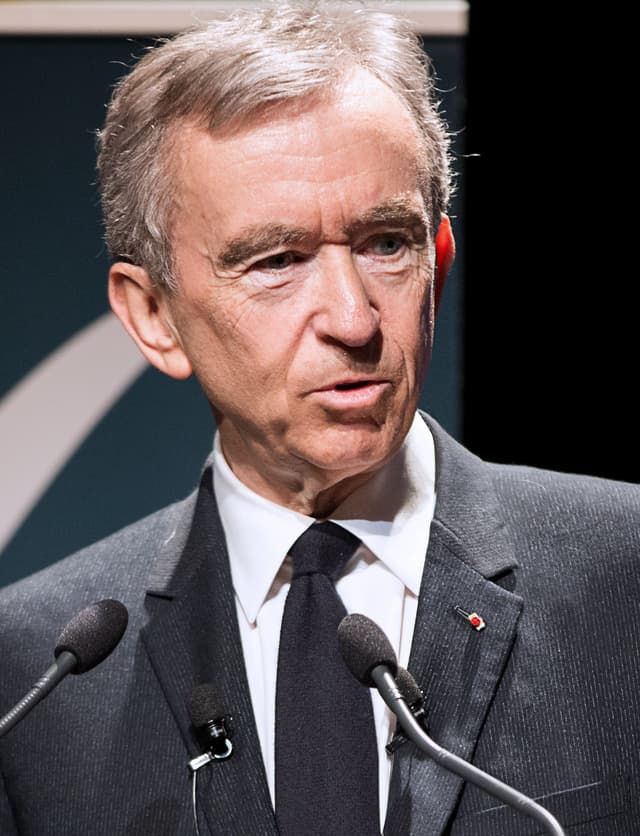
Bernard Arnault
LVMH
A visionary in the fashion and luxury industry, Bernard Arnault has led LVMH (Moët Hennessy Louis Vuitton) to become the world's largest luxury goods conglomerate, boasting a market capitalization of over $400 billion. His belief that exceptional talent combined with relentless work ethic creates an unstoppable competitive advantage has driven LVMH's expansion, including the acquisition of over 75 prestigious brands under its umbrella. Arnault maintains absolute control of his business, viewing challenges as opportunities for growth, a philosophy that has resulted in remarkable turnarounds for struggling assets. His keen eye for detail is reflected in his direct involvement in store designs, as evidenced by his recent communication with his son Antoine regarding a unique bar concept for a Tokyo location.
Core Principles
competitive advantage
A strong brand commands pricing power. Raise prices without losing customers because the brand's moat allows it. This is ultimate leverage in business.
After acquiring Tiffany, Arnault raised prices to position it as high-end jewelry. Average customer spend increased from $500 to $2,000. Charlie Munger notes that few businesses have untapped pricing power that managers fail to use, but great brands always do.
“What's key is that we attract high end consumers and sell a lot of high end jewelry, which was not the case before we bought the company.”
Defend competitive position aggressively. Don't tolerate rival dominance in retail locations or market share. Use your structural advantages to systematically displace competitors.
When competitors complain about LVMH's power, Arnault dismisses their concerns, noting that usually the strongest competitors don't complain. He views competitive advantage as earned through execution, not something he owes rivals.
“We have good and efficient competitors and we have competitors who are not as good. Usually the ones who complain are the ones who are not the best. They need excuses.”
culture
Obsessive attention to detail across all levels of the organization signals that quality matters. This motivates teams and creates consistency that separates great brands from good ones.
Arnault personally reviews store details, noting everything from chair placement to salesperson shoes. He sends detailed bullet-point emails about perceived deficiencies. This echoes Walt Disney's principle that if you lose the details, you lose everything.
customer obsession
Understand that brands are fundamentally about psychology and status. Luxury products sell because they provide access to an exclusive club and convey status, not because of functional superiority.
Arnault grasped that luxury is a business of selling names, logos, and implicit promises of exclusivity, not just physical objects. A luxury handbag might sell for 10 times its production cost because of the brand's promise of status.
finance
Patient capital and cash reserves are powerful weapons. When others are forced to sell, a buyer with cash and the emotional discipline to wait can acquire assets at distressed prices.
During the October 1987 stock market crash, LVMH shares plummeted 50%. While competitors and existing shareholders panicked and sold, Bernard quietly accumulated shares at record low prices. He had raised 1.5 billion francs in credit and was emotionally equipped to attack while others scrambled for survival.
Use financial engineering and leverage creatively to control much larger assets than your capital would otherwise permit. Cascade ownership structures allow you to maintain control while minimizing initial capital requirements.
Bernard used Russian doll cascading structures taught to him by Antoine. By owning 51% of a company that owns 51% of another company, he could control assets worth billions while deploying a fraction of that capital. He would take portions of companies public to raise capital without losing control.
hiring
Bet on talent and individuals who show exceptional ability and drive. Hire or acquire talent first, then figure out how to use them later. Talent is the scarcest resource.
Bernard recognized Christian Lacroix as an exceptional designer and invested heavily in him, committing 70 million francs initially and up to 250 million over five years, even though he had no immediate use for Lacroix. The principle mirrors Rockefeller's approach: talent was everything, and you secure it before opportunities arise.
“He was certain that he should not let Christian Lacroix slip through his fingers.”
Never stop upgrading your leadership team. Talent remains the highest-leverage investment, and fresh executive blood renews organizational energy and capability.
When acquiring Tiffany, Arnault's first action was adding senior executive talent, moving leaders from Louis Vuitton and installing his son alongside them. Executive quality directly determines brand trajectory.
Recruit creative talent strategically and then give them room to operate while backing them with strong management. Recognize that nonconformists and rebels produce the greatest value.
Arnault recruited Marc Jacobs to develop ready-to-wear at Louis Vuitton against executive resistance. Rather than constrain Jacobs, he gave him freedom while backing him with strong LVMH management. The new line generates 10% of sales but drives constant media attention that benefits the entire brand.
“Arnault is clever enough to realize when someone is an extremely creative personality that you need to give the horse room to run and then back up that talent with strong LVMH management.”
innovation
Recognize value in overlooked places before others do. Successful founders see opportunity where the industry sees none or dismissal.
In the 1980s, luxury was not considered a real industry, just craftmanship. Arnault understood before anyone else that luxury could be systematized, scaled, and globalized. Similarly, Sam Walton saw much more business in small-town America than anyone imagined.
“Arnault believed that luxury brands could be larger than anyone at the time imagined.”
leadership
Maintain absolute control of your business. Never relinquish control to investors, partners, or boards, as control is the foundation of long-term power and wealth creation.
Bernard systematically avoided sharing power with partners or bankers. When buying Boussac, he ensured majority ownership. With LVMH, he used Russian doll cascading structures to maintain control while minimizing capital outlay. He refused to be at the beck and call of bankers or any external stakeholder.
“I am the boss. I shall be here on Monday morning and I shall be running the company in person. There will be no power vacuum.”
Build and cultivate relationships with powerful, intelligent people. Seek mentorship from those who have already achieved what you aim to accomplish, and let them educate you in their domain.
Bernard deliberately sought out Antoine Bernheim at Lazard bank, his future mentor. He also built relationships with John Kluge and other high-performing executives. These relationships provided both financial capital and intellectual education in complex financial engineering, cascading structures, and deal-making.
Demand excellence from your team and move with speed and intensity. Push people beyond what they think is possible. Slowness and complacency are intolerable.
Bernard was notorious for setting impossible deadlines and expecting immediate results. When an executive complained about workload, Bernard ignored the objection and reconfirmed the commitment. He called executives to ask about sales results just two hours after assigning tasks. This created a culture of velocity and accountability.
Efficiency and results matter more than charisma or public appeal. Focus on what produces measurable outcomes, not on being liked or popular.
Bernard was not concerned with being charismatic or liked. He was known for ending lunches abruptly if he felt nothing more could be accomplished. His approach was purely functional and metrics-driven. This was foreign to the traditional French luxury world but ultimately proved superior.
“If Arnault has a religion, it is efficiency.”
Build a personal brand of competence and reliability before making major moves. People will support you if they believe you are capable and serious, even if you are young or inexperienced.
Bernard impressed the French government and banking establishment through his competence and detailed knowledge. This reputation preceded him. When he approached ministries about Boussac, they took him seriously not because of his age or background, but because he demonstrated mastery of his domain.
marketing
Use direct confrontation and rapid campaigns to capture market attention. Speed and decisiveness create news and momentum that money alone cannot buy.
When Princess Diana was photographed carrying a Dior handbag in Argentina in 1995, Arnault immediately renamed it the Lady Dior and exploited the resulting frenzy to sell hundreds of thousands of bags. The campaign generated revenue that strengthened Dior's finances and allowed elimination of dilutive third-party licenses.
Use controversy and gossip as free advertising. When managed well, negative attention creates awareness that costs nothing and spreads globally.
LVMH invested 350 million in the Tiffany flagship store and hung a Basquiat painting. The company suggested Basquiat intended a reference to Tiffany Blue, which the art world found implausible and distasteful. The resulting global newspaper coverage provided free advertising worth far more than the ad spend.
mindset
Exceptional talent combined with relentless work ethic creates an unstoppable competitive advantage. Those who are not naturally gifted must compensate through disciplined, sustained effort.
Bernard was not content to rely solely on ability. As a child and young adult, he worked constantly while peers played, studying intensely and developing expertise. He attributed his success to this deliberate practice rather than innate talent, claiming he worked because he was not gifted enough.
“You have to be specially gifted or you have to work hard. I was not gifted enough. I had to work. So I worked.”
Never underestimate your competitors or those working against you. Dismissing someone as inferior is all downside, no upside. Assume they are more capable than they appear.
Henri Rocamere and Alain Chevalier brought Bernard into LVMH thinking they could use him and control him. Other competitors dismissed him as a young property developer with no place in luxury goods. They were proven catastrophically wrong. Bernard silently accumulated shares and displaced both co-founders within two years.
“They'll never give Boussac to a 36-year-old property developer living in the United States. Everyone underestimated Bernard.”
Never stop. Maintain perpetual motion and constant reinvestment. Success is not a destination but an ongoing process of acquisition, restructuring, and expansion.
At age 42, when he had already built a massive empire, Bernard was asked when he would retire. He implied he had no plans to retire. The book notes his constant movement: buy a company, restructure it, sell pieces for capital, buy another company. This relentless cycle defined his entire career.
“By the time I'm 70, I'll have retired long since.”
Use intuition combined with deep analysis. Trust your gut feeling when something feels wrong, even if the logic appears sound on paper.
Rocamere had a premonition when he shook Bernard's hand at their first meeting. He described his handshake as like holding a limp rag but rationalized away the feeling. Later, he realized his intuition had been correct. Bernard valued this kind of instinctive judgment despite his analytical nature.
Study and learn constantly. Reading, observation, and asking questions should be lifelong practices. Excellence is built on accumulated knowledge, not raw talent.
Bernard's entire childhood was defined by study and work, not play. This habit never left him. He examined several companies a week in minute detail. He questioned everything about operations, cost structures, and processes. His success was built on this relentless learning discipline.
“The boy would listen attentively, a habit that he was never to lose.”
operations
Own your distribution channels and control the customer experience. Do not outsource this critical function to licensees or third parties, as it dilutes your brand and limits profitability.
Louis Vuitton in 1978 had only two company-owned stores. Bernard understood that controlled distribution was essential to maintaining luxury positioning and quality. He began building a network of owned boutiques rather than relying on external distributors, a strategy he continued across all LVMH brands.
Learn the operational details of your business through direct observation and questioning. Move beyond surface-level knowledge and understand cost structures, workflows, and inefficiencies.
Bernard visited construction sites and spoke directly to subcontractors when he was in his father's business. At Dior, he immediately questioned why they had 260 licenses, poor quality control, and weak distribution. This deep learning enabled him to identify what needed to change.
product
Target timeless, proven brands with deep heritage and loyalty. These brands have survived multiple economic cycles and consumer preference shifts, proving their durability and rare value.
Bernard did not invent luxury brands. He identified Christian Dior, Louis Vuitton, Moet, Hennessy, and Givenchy, each with centuries of heritage. He recognized that time acts as a filter for quality. These brands could not be replicated and would retain value regardless of economic conditions.
“The president of Dior is better known than the president of France.”
When acquiring a distressed brand, identify the core magic and systematically fix everything else. A powerful brand foundation is the most valuable asset to preserve.
When Arnault acquired Dior, it had strong heritage but multiple problems: too many licenses, insufficient boutiques, failed ready-to-wear, and poor culture. Arnault eliminated licenses to control quality, raised prices, and rebuilt the brand without questioning its core value. Dior grew from 3 stores and 90 million euros to 439 stores and 9.5 billion euros in sales.
resilience
Resist criticism and dismiss popular opinion as motivation rather than discouragement. Consensus that something is foolish is often a signal that you have identified an opportunity others lack the vision to see.
Everyone told Bernard he was crazy to buy Boussac. They said get on a plane back to the United States. His father said you are out of your mind. This chorus of opposition actually motivated him further. He later noted that when people criticized his luxury goods strategy, he pressed harder, and those same people eventually copied him.
“Far from discouraging him, this consensus of opinion acted as a stimulus.”
Frameworks
Russian Doll Cascading Structure
A financial engineering technique where a parent company owns 51% of a subsidiary, which itself owns 51% of another company. This cascading chain allows control of vastly larger assets while minimizing initial capital requirements. Each layer can be partially taken public to raise capital without losing ultimate control. The structure generates leverage through the financial markets rather than through debt.
Use case: When you need to control large assets but have limited capital. Useful for acquisitions and maintaining control while raising public funds. Particularly effective in markets with strong institutional investors.
Portfolio Autonomy with Shared Infrastructure
Combine independent brands under one holding company where each brand maintains complete autonomy over creative decisions, product design, brand identity, and management, while the parent company provides back-office functions, supply chain efficiency, retail location expertise, and executive talent recruitment. Stronger brands subsidize weaker ones while all benefit from scale advantages.
Use case: Building conglomerates in fashion, luxury goods, or any multi-brand holding structure; consolidating fragmented family-owned businesses; creating synergies without destroying brand differentiation
Obsessive Detail Standard-Setting
Leader maintains a database of best practices across thousands of examples and personally reviews operational details across the organization to identify incongruities that violate brand standards. This signals that quality matters at every level and prevents organizational drift toward mediocrity.
Use case: Scaling organizations while maintaining quality consistency; onboarding new executives into quality culture; preventing brand dilution through franchises or acquisition integrations
Retail Real Estate Leverage
Control or own premium real estate locations in major markets through a private equity or real estate arm. This creates multiple revenue streams (LVMH store operations, leasing to rivals, property appreciation) and provides structural competitive advantage by controlling which brands access top locations while displacing competitors when their leases expire.
Use case: Creating barrier to entry for competitors; capturing real estate appreciation upside; building neighborhood transformation projects (Design District model); controlling distribution channels for branded products
Stories
Arnault sent his son Antoine a message referencing a bar concept from a Berluti store design 12 years earlier, asking him to recreate it in a Tokyo location. His son Alexandre experienced similar detail-obsessed critiques during a Dubai store visit, where Arnault commented on chair placement and salespeople's shoes. His son reflected that after seeing tens of thousands of stores over decades, these details immediately stand out.
Lesson: Extreme attention to detail compounds over time. Volume of experience creates pattern recognition that allows leaders to spot problems invisible to others. This signals organizational values and prevents quality drift.
In 1992, Arnault visited China for the first time to open a Louis Vuitton store in the Beijing Palace Hotel basement. The country had no cars and hotels without hot water. Arnault later noted he called the Vuitton CEO asking if anyone would actually buy luxury goods. The CEO said yes, and LVMH became an early entrant to China's economic explosion.
Lesson: Great founders recognize emerging markets before they're obvious. Early entry into nations or sectors experiencing explosive growth creates decades of compounding returns. Trust in brand value even when external conditions seem unlikely to support it.
Marcel Boussac's conglomerate was bankrupt with Christian Dior as its crown jewel. When Arnault proposed buying just Dior, the sellers rejected it: it must be all or nothing. Arnault secured financing, bought the entire group, and systematically stripped away underperforming assets while keeping Dior. The brand grew from 3 stores and 90 million euros to 439 stores and 9.5 billion euros.
Lesson: Sometimes seemingly unfavorable acquisition terms become advantages. The unwanted assets provide negotiation leverage and later stripped-away value, while the core brand's potential justifies the entire investment. Aggressive capital deployment combined with surgical cost-cutting transforms distressed acquisitions.
LVMH invested 350 million dollars revamping Tiffany's Fifth Avenue flagship store. To generate attention, the company hung a Basquiat painting resembling Tiffany Blue and suggested the late artist intended a deliberate reference to the jeweler. The art world found this implausible and distasteful, but the resulting controversy was covered in newspapers worldwide, generating free global advertising.
Lesson: Managed controversy drives earned media that money cannot buy. In luxury branding, even negative critical attention increases brand visibility and creates cultural conversation. Smart operators exploit this dynamic to amplify paid marketing investments.
Arnault pulled Louis Vuitton out of Bal Harbour mall in Miami, where luxury retailers had concentrated for decades. He then invested in transforming an area of empty warehouses into the Design District with El Catterton real estate partnerships. The neighborhood became a world-class luxury shopping destination while Bal Harbour declined. Arnault controlled where customers shopped through location strategy.
Lesson: Real estate control creates structural competitive advantage. By owning or controlling premium locations, you determine which competitors thrive and which decline. This leverage extends far beyond the current generation of stores.
Notable Quotes
“Once you've seen tens of thousands of stores over the years, I think it's what comes to your mind immediately.”
Explaining how decades of observation create pattern recognition that reveals flaws instantly to experienced operators
“Maybe the economy will not be as good in 2024 as it was in 2023. What I have in mind is 2030. Every one of our plans are aimed at this.”
Demonstrating long-term thinking horizon when addressing concerns about near-term luxury spending pullback
“Every morning I have fun when I arrive.”
Explaining his motivation to continue working despite being 75 years old and worth 200 billion dollars
“What's key is that we attract high end consumers and sell a lot of high end jewelry, which was not the case before we bought the company. I'm very confident about Tiffany, but it takes time. You cannot do things instantly.”
Discussing the strategy to reposition Tiffany upmarket and the patience required for brand transformation
“If we put various luxury brands together, or in all reason, they can reinforce one another. The stronger brands compensate for the weaker ones and give them time to establish an identity and grow.”
From 'The Taste of Luxury' biography, articulating the portfolio strategy that became LVMH's foundation
“We have good and efficient competitors and we have competitors who are not as good. Usually the ones who complain are the ones who are not the best. They need excuses.”
Responding to rival complaints about LVMH's competitive dominance in retail and real estate
“I saw how the luxury market was made up of many medium-sized companies that, taken together, could be much stronger in a group composed of several brands.”
Explaining the insight that led to LVMH's consolidation strategy after acquiring Dior
Frequently Asked Questions
What are Bernard Arnault's key business principles?▼
Bernard Arnault's core principles include: A strong brand commands pricing power. Raise prices without losing customers because the brand's moat allows it. This is ultimate leverage in business.. Defend competitive position aggressively. Don't tolerate rival dominance in retail locations or market share. Use your structural advantages to systematically displace competitors.. Obsessive attention to detail across all levels of the organization signals that quality matters. This motivates teams and creates consistency that separates great brands from good ones.. Founder Almanac has cataloged 30 total principles from Bernard's career.
What can entrepreneurs learn from Bernard Arnault?▼
Key lessons from Bernard Arnault include: Extreme attention to detail compounds over time. Volume of experience creates pattern recognition that allows leaders to spot problems invisible to others. This signals organizational values and prevents quality drift.. Explore 5 stories and 4 frameworks from Bernard's experience.
What is Bernard Arnault known for in business?▼
A visionary in the fashion and luxury industry, Bernard Arnault has led LVMH (Moët Hennessy Louis Vuitton) to become the world's largest luxury goods conglomerate, boasting a market capitalization of over $400 billion. His belief that exceptional talent combined with relentless work ethic creates an unstoppable competitive advantage has driven LVMH's expansion, including the acquisition of over 75 prestigious brands under its umbrella. Arnault maintains absolute control of his business, viewing challenges as opportunities for growth, a philosophy that has resulted in remarkable turnarounds for struggling assets. His keen eye for detail is reflected in his direct involvement in store designs, as evidenced by his recent communication with his son Antoine regarding a unique bar concept for a Tokyo location.
More Fashion & Luxury Founders
Want Bernard's advice on your business?
Our AI has studied Bernard Arnault's biography, principles, and decision-making frameworks. Ask any business question.
Start a conversation