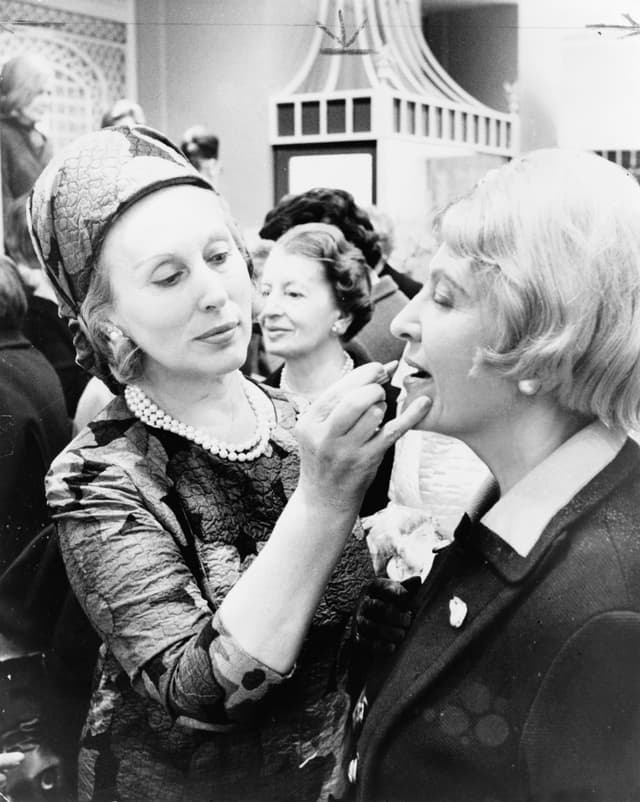
Estée Lauder
Estée Lauder Companies
A pioneer in the beauty industry, Estée Lauder founded Estée Lauder Companies in 1946, transforming it into a global powerhouse that generated over $14 billion in revenue by the late 1990s. Her unwavering belief in the timeless human desire for beauty and self-care guided her business philosophy, emphasizing the importance of fulfilling lasting needs over fleeting trends. Lauder's commitment to authenticity and intuition allowed her to build a brand that resonated deeply with consumers, while her famous quote, "First comes the wish. Then you must have the heart to have the dream. Then you work, and work, and work," reflects her relentless work ethic and passion for the industry. Today, her legacy continues to inspire entrepreneurs to align their passions with their business pursuits and to trust their instincts in the face of challenges.
Core Principles
competitive advantage
Separate yourself through relentless selling and resourcefulness, not price competition. Your competitors may be smarter or have more money, but they cannot compete with your willingness to work.
Estée had no large advertising budget, no sales team, no fancy offices. What she had was her ability to talk to people, make them up, create excitement, and follow up relentlessly. She would ride trains, visit beauty editors, work unpaid summers at hotels on Long Island. Her resourcefulness and effort were her competitive advantage.
“I operated full time on that precept. Make the most of what you have.”
The vendor, not the product, is the competitive advantage. Even excellent products fail if the entrepreneur is not passionate, clever, and personally committed.
When the buyer in Canada asked how Estée sold out everything so quickly, she responded: 'You don't sell cosmetics, you sell yourself.' Her passion for beauty and relentless personal engagement created a compelling customer experience that products alone could not achieve.
“You don't sell your products, you sell yourself. Soup, glue, or beauty can all be packaged in jars, tubes, and bottles and all vended like any other commodity. The big difference lies in you.”
culture
Involve your family in the business so that your obsession with building the company strengthens rather than destroys personal relationships. A family business allows spouses and children to share the mission.
After an initial divorce due to her obsession with business, Estée remarried her husband Joe and brought him into the company to manage finances while she handled sales and product. Their sons were given real responsibilities from childhood, including typing invoices, delivering packages, and learning the business through correspondence while in college.
“I refuse to either choose business or family. I wanted both. We were never to be separated for longer than a few days ever again.”
customer obsession
Never underestimate customers based on appearance or perceived economic status. Every person has a desire for beauty and the means to purchase. Treat everyone with respect and full effort.
A sales associate in San Antonio told Estée not to waste time with a woman who looked like she couldn't afford anything. Estée ignored the advice, gave the woman a full demonstration, and she bought two of everything. The woman's relatives bought products the next day. Estée learned that prejudging customers costs sales and dishonors the customer.
“Never be patronizing. Never underestimate any woman's desire for beauty.”
Never discount the potential of small markets or economically modest communities. People everywhere will pay for perceived value if convinced of worth.
Estée rode buses for six hours to open a store in small-town Corpus Christi, Texas, despite advice that the clientele was modest in size and economics. She treated the opening with the same rigor as any major city launch.
“No community was too small for my attention. Never underestimate people who live in small towns or those with limited budgets. People, no matter where they live or on what their finances will spend if they're convinced of worth.”
Never underestimate any customer based on appearance, wealth, or status. Treat every person with full attention and respect, as they may become loyal advocates or spend more than expected.
At a store opening in San Antonio, a salesperson warned Estée not to waste time on a barefoot woman with gold teeth. Estée gave her a full makeover anyway. The woman bought two of everything, and her relatives made purchases the next day.
“Never be patronizing. Never underestimate any woman's desire for beauty. That proud woman embodies my entire philosophy.”
Customer loyalty built through genuine service and goodwill is worth far more than any single transaction. Give gifts with purchase and even gifts without purchase to ensure customers leave with a positive experience.
Estée pioneered the 'gift with purchase' technique decades before it became standard. She would give samples of products customers did not buy and often gave gifts without any purchase at all, knowing that if women tried her products at home, they would become lifelong customers.
“A woman would never leave empty-handed. I did not have an advertising department. I did not have a copywriter. But I had intuition. I just knew that gift with a purchase was very appealing.”
execution
Act with urgency on important opportunities and insights. If you do not act immediately when you recognize something important, you probably never will.
When Helen Blake mentioned that a merchandise manager at Woodward department store had complimented Estée's appearance and asked about her cosmetics, Estée called immediately rather than delaying. She emphasized that timing and immediate action separate successful entrepreneurs from those who procrastinate.
“If you do not do important things when you think of them, you probably never will and you will lose out.”
finance
Invest your entire savings into inventory when you get your first big retail break. Stock depth proves the business works and prevents the retailer from dropping you.
When Saks gave her an initial eight-hundred-dollar order, Lauder invested all their savings into inventory and product creation. This prevented stockouts and ensured consistent sales, demonstrating the strength of the business and making the retailer confident in expanding.
“Breaking that first mammoth barrier was perhaps the single most exciting moment I have ever known. We had to have enough faith in our work to invest all of our savings.”
Controlling costs is the foundation upon which other competitive advantages are built. A manager should maintain lean operations from the start, not as a reactive measure but as an embedded organizational practice.
Estée Lauder partnered with her husband Joe to focus on finances and cost control while she managed sales and product. This discipline allowed them to offer lower prices, drive growth, and spread fixed costs across more sales, creating a flywheel effect that competitors could not match.
“You can make a lot of different mistakes and still recover if you run an efficient operation, or you can be brilliant and still go out of business if you're too inefficient.”
focus
Learn to say no consistently. Saying yes to everything stems from a childish desire to please and prevents focus.
Lauder maintained extreme focus on her vision by saying no to inferior products, ideas, and distractions. She understood that saying yes to everything dilutes your effort and compromises your standards. Selective no-saying was essential to building a luxury brand.
“Saying yes all the time stems from a childish desire to please and to be loved. You must say no to inferior products and ideas.”
Maintain an unwavering focus on a single target and do not allow distractions to pull you away. Success comes from sustained attention to your core goal over many years.
Estée emphasized that her entire life was about fulfilling her dream of building a beauty empire. She kept her eye on the target and never allowed it to stray, maintaining focus through setbacks, slow growth, and competing demands.
“I keep my eye on the target, whatever that target was. I've never allowed my eye to leave the particular target of the moment. Success comes from not letting your eyes stray from the target.”
hiring
Train your salespeople obsessively on how to represent your brand. The quality of customer interactions is more important than the number of employees. Better to have five trained salespeople than fifty untrained ones.
Estée interviewed approximately 40 people to hire one salesperson. She checked with each salesperson daily to make sure she was selling as Estée would. She personally opened every store to train the sales team on how to present merchandise, create atmosphere, and relate to customers. This obsession with execution quality became her brand.
“I made it my business to check with each of them each day to make sure she was selling as I would.”
innovation
Identify unmet needs by solving your own problems first. Look for product category innovations, not just product innovations.
Lauder noticed women wouldn't buy their own perfume, only receive it as gifts. She created Youth Dew as a bath oil that doubled as a skin perfume, making it acceptable for women to buy for themselves. By changing the product category, she created a new market. By 1984, Youth Dew alone generated over 150 million dollars in sales.
“Instead of using their French perfumes by the drop behind each ear, women were using Youth Dew by the bottle in their bathwater. It doesn't take a graduate of business school to figure out what that meant. Sales. Beautiful sales.”
Learn from competitors' ideas without copying them. Innovation means finding a completely new way of looking at old things.
Lauder emphasized that studying competitors was valuable for inspiration, but the goal was to do it better, not to replicate. She looked for ways to completely reframe existing categories rather than making incremental improvements on competitor products.
“Innovation doesn't mean inventing the wheel each time. Innovation can mean a whole new way of looking at old things.”
Identify overlooked customer needs and solve them in unexpected ways. A question like 'How can I get women to buy their own perfume?' can unlock entire business lines.
Estée noticed that women did not buy perfume for themselves, only received it as gifts on special occasions. Rather than calling her new product perfume, she created Youth Dew bath oil that doubled as a skin perfume. Women felt comfortable buying their own bath oil, and by 1984, Youth Dew alone generated over $150 million in annual revenue.
“I would not call it perfume. I would call it youth do a bath oil that doubles as a skin perfume. That would be acceptable for them to buy because a woman would buy her own bath oil.”
leadership
Invest in mentorship early. Seek out people already doing what you dream of doing and learn directly from them through observation and apprenticeship.
When Estée was a teenager, her Uncle John became her mentor. He was a skin specialist who created beauty formulations. Instead of dismissing her interest, he taught her his craft in a makeshift laboratory. He validated her dreams and showed her the actual work of creating beauty products. This mentorship redirected her entire life path.
“Do you know what it means for a young girl to suddenly have someone take her dreams quite seriously to teach her secrets?”
Develop peer relationships and alliances within your industry. Other successful people in your field can introduce you to opportunities and accelerate your growth if you build genuine relationships.
Estée cultivated relationships with people who worked in beauty at other companies. One woman, Helen Blake, would casually mention buyers and magazine editors she knew to Estée. These introductions opened doors. Estée calls this networking and says it is one of the most powerful tools in business.
“Never underestimate the value of an ally. Today, they call this networking, the sharing between business colleagues. It is one of the most powerful tools in the business.”
Build a business with a partner or spouse who has complementary skills. Estée's obsession with product and sales had to be balanced by Joe's financial management and stability.
Estée was visceral, action-oriented, and singularly focused on building the business. She neglected financial details and personal relationships. When she remarried Joe, they became equal partners. He managed finances and provided stability while she drove the mission. He gave up his own business to support hers, and they had a 50-year partnership.
“We decided that Joe would give up his business and come into mine, where we would be equal partners in every sense of the word.”
Make strategic alliances and treat business contacts as friends. A network of advocates who recommend you to others amplifies your reach exponentially.
Estée cultivated relationships with beauty editors, department store buyers, and salon owners, inviting them to social events and genuinely befriending them. These alliances resulted in media coverage, store placements, and customer referrals that compounded over decades.
“Never underestimate the value of an ally. I used every second to make friends and to spread word about our products.”
Demand and expect perfection from yourself and your team. Never settle for mediocrity, as mediocrity compounds into failure over time.
Estée's obsession with perfection extended to every aspect of her business, from product formulation to packaging to customer service. She believed that if you push yourself beyond the furthest place you can go, you will achieve your heart's dream.
“You must expect and demand perfection and never settle for mediocrity. If you push yourself beyond the furthest place you can go, you'll be able to achieve your heart's dream.”
marketing
Use the gift-with-purchase model to get products into customers' hands without the barrier of purchase. Let the product's quality convince them in their own home.
Because she lacked advertising budget, Lauder gave away samples freely, sometimes even before purchase. She pioneered the gift-with-purchase model that became industry standard. Women who tried products at home with no purchase obligation were more likely to become loyal customers once they experienced the quality firsthand.
“A woman would never leave empty-handed. The idea was to convince a woman to try the product. Having tried it at her leisure in her own home and seeing how fresh and lovely it made her look, she would be a faithful customer of that, I had not one single doubt.”
When you lack advertising budget, out-teach your competition instead. Become the authority through sharing knowledge and emotional enthusiasm.
Unable to afford traditional advertising in the early years, Lauder invested in product demonstrations and personal teaching. She brought charisma and knowledge about customers' possibilities, creating emotional experiences around beauty education. This teaching approach converted customers more effectively than paid ads could have.
“For me, teaching about beauty was and is an emotional experience. I brought them charisma and knowledge about their possibilities. Pure theater.”
Word-of-mouth is your most powerful marketing tool. Invest in creating products and experiences that women will tell other women about.
Lauder called word-of-mouth her secret weapon before television and mass advertising. She knew that women telling women about her cream before they even visited her salon was worth more than any paid campaign. She built her business intentionally to create experiences and results worth talking about.
“Tell a woman was the word of mouth campaign that launched Estée Lauder cosmetics. Women were telling women they were selling my cream before they even got to my salon.”
When entering an important market, use media relationships to create demand before approaching retailers. Let customers pull the product into stores.
When breaking into Harrods in London, Lauder first visited beauty editors and gave them samples and demonstrations. The resulting magazine coverage created customer demand. When she returned to the buyer, she could point to customer requests and press coverage, making the buyer's position untenable.
Maintain a consistent brand image and never compete on price. Decide you are luxury and act accordingly in every interaction.
From the beginning, Lauder positioned herself as selling top-of-the-line products, not budget alternatives. She maintained this positioning in pricing, packaging, store selection, and customer interactions. This consistency meant her brand never confused the market about what it represented.
“We do the best skin products available today. We are not a budget market and we know it.”
Frameworks
The Gift-With-Purchase Model
Give customers free samples of your product with or without purchase, allowing them to experience quality in their own home without purchase barrier. The goal is to let the product's quality convince them to become loyal buyers. Instead of advertising, invest the budget in producing enough inventory to give away large quantities.
Use case: Early-stage beauty and consumer product companies with limited advertising budgets looking to build loyal customer bases through product trial
The Personal Presence Strategy
Be physically present at every store opening, counter launch, and major market entry. Train staff directly, meet customers one-by-one, and make yourself the visible face of the brand. Work long hours at each location until the business is stable and standards are established.
Use case: Growth and scaling stage companies expanding to new locations or markets where hands-on oversight ensures brand consistency and customer relationships
The Media-First Market Entry Strategy
When entering a prestigious retailer or market where direct sales approaches are being rejected, first build demand through media relationships. Share your product with beauty editors and journalists to generate coverage, then return to the retailer once customer demand and press attention make them reconsider.
Use case: Growth stage companies seeking placement in premium retailers who have initially rejected you, particularly in competitive or mature markets
The Luxury Positioning Strategy
Decide early that you are building a luxury brand, not a budget alternative. Maintain this positioning consistently across pricing, packaging design, store selection, customer interaction, and product quality. Never compete on price or apologize for premium positioning.
Use case: Any stage company entering the beauty, fragrance, or luxury goods market where clear brand positioning prevents confusion and protects margins
The Family-Secret Protection Model
Keep your complete product formula secret by having only one family member hold the final critical percentage or ingredient. Suppliers and manufacturers never see the complete formula, making it impossible for competitors or factories to replicate the exact product.
Use case: Product-based companies with proprietary formulas or recipes in industries like cosmetics, fragrance, food, or pharmaceuticals where formula theft is a competitive risk
The Category Innovation Framework
Look for unmet needs by identifying products people won't buy in their current form. Rather than launching another version of the existing product category, redefine the category to make it socially acceptable or practical for a new use case. This creates a new market rather than competing in an existing one.
Use case: Growth stage companies in beauty, consumer goods, or lifestyle products seeking to expand addressable market beyond traditional buyer profiles
The Tell a Woman Campaign
Estée's word-of-mouth strategy for building demand without advertising budget. Instead of buying ads, invest that money into product samples and demonstrations. Get women to try the product. They tell other women. Demand builds organically. Retailers eventually must stock the product to meet customer requests.
Use case: Bootstrap businesses or consumer product companies with limited advertising budgets that need to build customer demand before approaching retailers or investors.
Build Demand First, Then Retailer Follow
Create customer enthusiasm and demand for your product before approaching major retailers. Visit beauty editors and media to generate buzz. Do product demonstrations. Collect customer testimonials. Build a waiting list of women asking for your products in stores. Retailers will then have no choice but to stock your products to meet customer demand. This gives you negotiating power.
Use case: Launching consumer products into new markets or geographic regions where you lack existing distribution or relationships with buyers.
The Gift with Purchase (without requiring purchase)
Never let a customer leave empty handed. If they buy, give them a gift. If they don't buy, give them a sample or something small to take home. The goal is to get the product into their hands so they will try it at home. Quality will speak for itself. The gift also creates a sense of obligation and reciprocity. Even small samples of powder, lipstick, or oil keep the brand top of mind.
Use case: Sampling and trial strategies for consumer products, beauty, skincare, or any product where trial predicts purchase. The sample is the most honest sales tool because it lets the product prove itself.
Tell a Woman Word-of-Mouth Campaign
Build your distribution entirely on satisfied customers recommending your product to their peers. Women tell women about products they love, creating organic viral growth without advertising. Amplify this by training customers to evangelize, giving them stories and benefits to share.
Use case: Early-stage product launches with limited advertising budgets, consumer goods, and beauty products. Most effective before digital marketing when word-of-mouth was the primary information channel.
Stories
A woman at a beauty salon complimented the rude receptionist on her blouse. The woman replied coldly, 'What difference could it possibly make, you could never afford it?' Young Estée walked away with her heart pounding and face burning, making a promise to herself.
Lesson: Negative interactions can become catalysts for achievement. The desire to prove naysayers wrong can fuel long-term motivation and persistence, though it's better to build on positive vision than pure spite.
Lauder spent weeks visiting friends' homes and elegant restaurant bathrooms to match jar colors against wallpapers. She visited silver, purple, black and white, brown, gold, pink, and red bathrooms to determine which color would harmonize with any decor.
Lesson: Product design details matter enough to invest extraordinary time. Understanding how your product fits into customers' lives and making them proud to display it requires research and obsessive attention that competitors won't match.
Lauder met her Uncle John, a Hungarian skin specialist who produced creams on a gas stove. Watching him work hypnotized her, and she felt an immediate recognition of her true path. His willingness to teach her and take her dreams seriously fundamentally changed her self-belief.
Lesson: Finding a mentor who takes your dreams seriously early in life compounds confidence and knowledge. The right guidance at the right time can clarify your life's direction and accelerate learning.
For years while raising a family and working, Lauder cooked small pots of cream in spare moments, always experimenting and improving. She describes feeling most alive while dabbing in cream, conducting a secret absorbing experiment. Her dream was delayed but her obsession continued to grow.
Lesson: A delayed dream with a growing obsession eventually manifests. Sustained practice and passion during the waiting period actually deepens your expertise and readiness for when opportunity arrives.
When the owner of the beauty salon asked if Lauder wanted to run the beauty concession, she accepted immediately. She would pay rent and keep whatever she sold. She had no partners and was willing to risk the rent to finally start the business she always dreamed about.
Lesson: Be ready to bet everything when the right opportunity arrives. The transition from hobby to business often requires financial risk, but if you've built sufficient knowledge and belief, the risk is justified.
Lauder was rejected by Saks Fifth Avenue multiple times. But women were already calling Saks asking for her products based on word-of-mouth from the beauty salons. When the buyer finally relented, they placed a small order for eight hundred dollars. Lauder invested all her savings into inventory.
Lesson: Customer demand from multiple directions eventually breaks through gatekeepers. Invest completely when you get your first institutional break, ensuring you never stock out and proving the business model works.
Attempting to break into Harrods in London, Lauder was repeatedly rejected by the buyer. She instead visited beauty editors, gave product demonstrations and samples, and generated press coverage. After articles appeared about Estée Lauder coming to London, customers began asking for it, forcing the buyer to reconsider.
Lesson: When direct sales approaches fail, build demand from the customer side using media. Let customers pull the product into the retailer rather than convincing the retailer to push it.
Lauder identified that women wouldn't buy their own perfume because it was traditionally a gift item. She created Youth Dew as a bath oil that doubled as a skin perfume, making it acceptable for personal purchase. Women used it by the bottle instead of by the drop. By 1984, Youth Dew generated over 150 million dollars in annual sales.
Lesson: Category innovation creates bigger markets than product innovation. Look for why customers won't buy in the current form, then reframe the category to remove barriers and create new use cases.
As a young girl, Estée complimented a woman at a beauty salon on her blouse. The woman replied, 'What difference could it possibly make? You could never afford it.' The rejection stung deeply. Estée promised herself that one day, no one would ever make her feel that way again. This painful moment became the catalyst for her obsession with beauty and self-improvement.
Lesson: Pain and rejection can become fuel for ambition if channeled correctly. The woman who rejected Estée became an unintended mentor, showing her the power of confidence and the pain of being judged. This memory never left her and drove decades of effort to build an empire.
Estée's Uncle John was a skin specialist who created beauty formulas in their home on a gas stove. When he taught her his craft, she said she felt irrevocably bewitched. She built a makeshift laboratory in the stable behind her house and ran home from school every day to practice being a scientist. Her Uncle John validated her dreams and took her seriously as an apprentice.
Lesson: A mentor who takes your dreams seriously and teaches you the actual work of your field can redirect your entire life. Estée's Uncle John did not tell her she was too young or that beauty was not a real business. He treated her as a fellow scientist. This validation and education became the foundation of her empire.
Notable Quotes
“First comes the wish. Then you must have the heart to have the dream. Then you work, and work, and work.”
Opening statement from her autobiography written at age 80, describing the process of building dreams into reality
“Within each person is the potential to build the empire of her wishes, and don't allow anyone to say you can't have it all.”
From her autobiography, emphasizing unlimited potential and resistance to limitations
“I have always believed that if you stick to a thought and carefully avoid distraction along the way, you can fulfill a dream.”
From her autobiography, on the importance of focus and avoiding distractions
“Success depends on daring to act on your dreams.”
From her autobiography, on the necessity of action beyond dreaming
“Serenity is pleasant, but it lacks the ecstasy of achievement.”
From her autobiography, explaining her choice of ambition over comfort
“I have never worked a day in my life without selling. If I believe in something, I sell it and sell it hard.”
Core philosophy stated in her autobiography about selling being inseparable from work
“I believed in my product. I loved my product. A person has to love her harvest if she's to expect others to love it.”
On matching craft to passion, stated when discussing why she wouldn't have succeeded in another industry
“You're as beautiful as you think you are. The secret is to imagine yourself the most important person in the room.”
Her mother's teaching that shaped her early confidence and self-belief
“I learned early that being a perfectionist and providing quality was the only way to do business.”
Lesson from working in her father's hardware store
“A woman would never leave empty-handed. The idea was to convince a woman to try the product.”
On her pioneering gift-with-purchase technique
Frequently Asked Questions
What are Estée Lauder's key business principles?▼
Estée Lauder's core principles include: Separate yourself through relentless selling and resourcefulness, not price competition. Your competitors may be smarter or have more money, but they cannot compete with your willingness to work.. The vendor, not the product, is the competitive advantage. Even excellent products fail if the entrepreneur is not passionate, clever, and personally committed.. Involve your family in the business so that your obsession with building the company strengthens rather than destroys personal relationships. A family business allows spouses and children to share the mission.. Founder Almanac has cataloged 30 total principles from Estée's career.
What can entrepreneurs learn from Estée Lauder?▼
Key lessons from Estée Lauder include: Negative interactions can become catalysts for achievement. The desire to prove naysayers wrong can fuel long-term motivation and persistence, though it's better to build on positive vision than pure spite.. Explore 10 stories and 10 frameworks from Estée's experience.
What is Estée Lauder known for in business?▼
A pioneer in the beauty industry, Estée Lauder founded Estée Lauder Companies in 1946, transforming it into a global powerhouse that generated over $14 billion in revenue by the late 1990s. Her unwavering belief in the timeless human desire for beauty and self-care guided her business philosophy, emphasizing the importance of fulfilling lasting needs over fleeting trends. Lauder's commitment to authenticity and intuition allowed her to build a brand that resonated deeply with consumers, while her famous quote, "First comes the wish. Then you must have the heart to have the dream. Then you work, and work, and work," reflects her relentless work ethic and passion for the industry. Today, her legacy continues to inspire entrepreneurs to align their passions with their business pursuits and to trust their instincts in the face of challenges.
More Fashion & Luxury Founders

Want Estée's advice on your business?
Our AI has studied Estée Lauder's biography, principles, and decision-making frameworks. Ask any business question.
Start a conversation