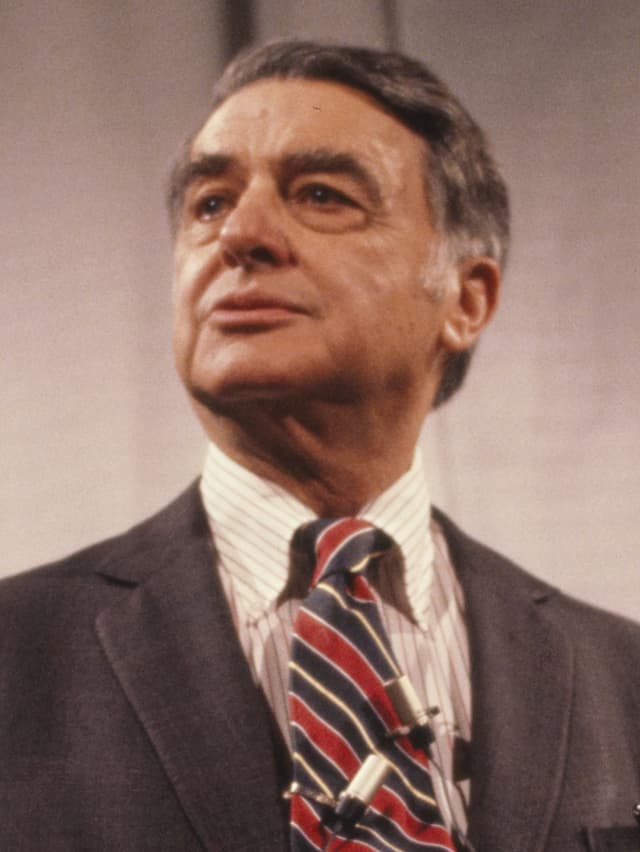
Edwin Land
Polaroid Corporation
An innovator in the realm of instant photography, Edwin Land co-founded Polaroid Corporation, where he revolutionized the industry with the introduction of the first instant camera in 1948. Known for his belief in self-education and problem-solving, Land famously broke into a laboratory to conduct experiments at Columbia University, demonstrating his relentless pursuit of knowledge and innovation. His philosophy emphasized learning across disciplines and applying historical insights to contemporary challenges, which enabled him to foresee the potential of the Polaroid camera even before it was built. Under his leadership, Polaroid generated over $3 billion in sales, illustrating how visionary thinking and practical experimentation can yield transformative results in business.
Core Principles
culture
Believe in the individual, not the group. Original thinking, profundity, and breakthrough creativity come from singular minds, not committees. Design your company to amplify individual greatness.
Land explicitly rejected the idea of group creativity or group originality. He valued individual contributors deeply and structured Polaroid around brilliant individuals doing their best work, not consensus committees. This allowed breakthrough innovations to emerge that consensus would have rejected.
“There is no such thing as group originality or group creativity or group perspicacity. I believe wholeheartedly in the individual capacity for greatness.”
Design a company for human flourishing, not just profit extraction. People should look forward to the day's beginning and regret its end. This creates loyalty and attracts talented people.
Even during the Great Depression when companies were collapsing, Land imagined a company founded on science that would create new products for unperceived needs and provide an environment where work life was so satisfying that employees wanted to arrive and dreaded leaving. This vision attracted exceptional talent.
Orient your team around a meaningful mission, not just compensation. Employees are motivated by believing they are solving an important problem that matters.
Land posted on a chalkboard in the lab: 'Every night, 50 people will die from highway glare.' This constant reminder ensured every employee understood they were working on a manifestly important mission, not just a commercial product.
“Every night, 50 people will die from highway glare.”
Protect your word choice and language carefully. Designate someone as 'Keeper of the Language' to ensure company communications reflect your values and vision.
Land elevated marketing executive Ted Voss to corporate officer with the four-word job description: 'Keeper of the Language.' Land believed language mattered profoundly and that corporate communications should be thoughtful, compact, and engaging mission statements, not just financial reports.
“Keeper of the Language.”
finance
Spend excessively on research and development relative to competitors. Use monopoly profits not for personal wealth but to fund relentless innovation that keeps you ahead.
Wall Street analysts criticized Land for overspending on R&D, but this philosophy fueled Polaroid's innovation. With 60% profit margins on film, Land reinvested aggressively in product development rather than extracting profits, maintaining technological leadership for decades.
“That was Land's philosophy. Do some interesting science that is all your own, and if it is, in his words, manifestly important and nearly impossible, it will be fulfilling.”
hiring
Optimize for breadth alongside depth. Surround yourself with people who have diverse interests, passions, and expertise across multiple domains, not just specialists in one field.
Land was introverted but cultured, with knowledge spanning art, music, literature, and science. He deliberately hired chemists who were also musicians and photographers who understood physics. This philosophy directly influenced how he built Polaroid's culture and attracted talent that could think across disciplines.
“Edwin Land liked people who had breadth as well as depth. Chemists who were also musicians or photographers who understood physics.”
Recruit undiscovered talent and train them your way rather than hiring fully-formed experts trained by competitors. Seek raw talent and instill your own culture and methodology.
Land developed a relationship with Clarence Kennedy, an art history professor at Smith College, who recommended his best students. This gave Polaroid access to talented, aesthetically-inclined women that few corporations were hiring at the time, while avoiding competition for MIT or Harvard graduates.
“I want somebody to come brand new to my company so I can teach them the way I do science and the way that we do our experiments. I don't want to have to take somebody that's already been trained up fully in the wrong ways to do things.”
leadership
Burn the boats: set a public deadline you cannot retreat from to force your team to achieve what they didn't think possible. The survival imperative becomes a more powerful motivator than abstract goals.
Facing near-bankruptcy after World War II, Land announced the Polaroid camera would be unveiled at the Optical Society of America meeting on February 21, 1947, even though his team was horrified by the deadline and unsure they could deliver. The public commitment forced them to overcome obstacles and work with urgency they wouldn't have otherwise summoned. They succeeded.
“He held on to this date as a weapon available for use against his own people, including himself, when their efforts slowed as he knew they would.”
Do not seek consensus or approval for your vision. If you're waiting for buy-in from others before proceeding, you're moving too slowly. Independent thinkers don't need external validation.
Land had minimal interest in the reactions of his employees or colleagues. He would make decisions based on his vision and expect people to execute. His mentor Julius Silver, who had known Albert Einstein and other great minds, called him 'the most extraordinary person I have ever met,' specifically because of his unwillingness to be swayed by conventional opinions.
“His interest in our reactions was minimal, polite, sometimes kind, but limited by the great drain of energy necessary to sustain his own part.”
Move with urgency when survival is at stake. Create artificial urgency even when physical survival isn't immediately threatened to prevent the complacency that kills companies.
After World War II, Polaroid faced bankruptcy with sales collapsing from $16 million to under $2 million. Land compressed the development timeline by setting a public announcement date. Even in successful periods, he pushed teams to work faster than seemed reasonable because he understood that complacency leads to death.
“It will be a race, a close race. If we win, we survive.”
Operate as a benevolent dictator with absolute control over the company's direction. The greatest entrepreneurs build companies, not democracies, with clear vision at the top.
Land's involvement in every decision was all-consuming. He circulated among offices asking probing questions, made late-night calls to employees, and maintained invisible presence over every organizational chart. While exhausting for employees, this intensity ensured alignment with his vision.
“Don't kid yourself. Polaroid is a one-man company.”
Cultivate intense concentration as a leadership practice and teach it to your team. Deep focus for extended periods unlocks human resources people didn't know they had.
Land would sometimes hide in the darkroom just to think intensely without interruption. He believed this concentrated thinking was the core of his leadership philosophy and explicitly tried to teach it to his team as a practice.
“My whole life has been spent trying to teach people that intense concentration for hour after hour can bring out in people resources they didn't know they had.”
marketing
Describe your product solution in human terms, showing how it solves actual problems. Compare it to the status quo to help customers understand the improvement you offer.
When demonstrating the instant camera, Land didn't lecture on technical specifications. Instead, he showed a blurred photo and said: 'This new process allows you to retake the picture immediately and correct the fault. You know that you have a perfect picture on the spot. You never need to be disappointed again.' He made the value tangible and emotional.
“This new process allows you to retake the picture immediately and correct the fault. You know that you have a perfect picture on the spot. You never need to be disappointed again.”
Rehearse product demonstrations obsessively, just as a performer would. Every detail matters, and the presentation is as much of the product as the product itself.
Land prepared for the 1947 Polaroid camera demonstration the way Steve Jobs prepared for product launches. He researched where the sun would be at meeting time, prepared the room with optimal lighting, and practiced every element. The gasp from the New York Times reporter who tipped over in his chair wasn't accidental; it was the result of meticulous preparation.
Demonstrate the product, not the marketing copy. No argument in the world can compare to one dramatic demonstration of what your product actually does.
In 1947, Land demonstrated instant photography by taking a photograph of himself at a table wearing a striped tie, then showing the instant print of himself in that same outfit moments later. The demonstration created such impact that newspapers across the country ran the story, generating massive free publicity.
“No argument in the world can ever compare with one dramatic demonstration.”
Position your product as aspirational, first-class, and premium, not as a commodity. Build for high margins and quality, not market share through price competition.
Polaroid was positioned as an aspirational product with elegant design and premium packaging. Rather than compete on price with commodity cameras, Land built only first-class products with 60% margins on film, enabling continuous reinvestment in R&D.
“He grasped that Polaroid could be positioned as an aspirational product and should be packaged and marketed that way.”
Make decisions that prioritize product integrity and impact over financial optimization. Your legacy compounds if you're willing to spend extravagantly on excellence.
Land imported 10,000 specially-colored Dutch tulips via KLM airline and coordinated a farmer to accelerate his crop just for a product demonstration. This was extraordinarily expensive but created unforgettable brand moments that money couldn't otherwise buy.
“It was another unforgettable Landian demonstration, this one at a god awful expense.”
mindset
Build a personal library and use it as a tool for solving problems. Continuous reading across disciplines allows you to synthesize information and recognize solutions to future problems you cannot yet see.
Land maintained extensive company and personal libraries throughout his life, cataloging books and photography materials. When facing a problem, he would go to the library to research historical solutions. Fred Smith, founder of FedEx, estimated he spent four hours daily reading while building his company, believing vision comes from synthesizing information across many disciplines.
“The common trait of people who supposedly have vision is that they spend a lot of time reading and gathering information and then they synthesize it until they come up with an idea.”
Drop out if the institution is moving too slowly relative to your ambition. Self-education through direct problem-solving and experimentation often surpasses formal credentials.
Land dropped out of Harvard twice because he felt his classmates were unserious and the pace was too slow. Instead, he spent time at the New York Public Library reading everything about polarized light, then broke into Columbia University's laboratory at night to conduct experiments. He became more accomplished than most PhD-holders, eventually receiving honorary degrees from Harvard, Yale, and other institutions.
“An education without a degree.”
Study the methods of historical figures, not just their outcomes. Apply their principles and work ethic to your own unique field rather than copying what they built.
At age 17, Land studied Michael Faraday, Thomas Edison, the Wright Brothers, and Alexander Graham Bell. Rather than imitating them, he extracted their approach to problem-solving, their dedication, and their independent thinking, then applied these methods to the field of polarized light, an area he believed offered unsolved problems worthy of his life's work.
“Faraday had moved the world forward a hundred years. Edison had compressed genius and energy enough for three lifetimes. I picked field after field before I decided that the great opportunity was polarized light.”
Concentrate ferociously on a single goal. Intense, uninterrupted focus for extended periods unlocks human potential and brings resources to light that people don't know they have.
Land spent decades focusing intensely on polarization technology, working 60-hour stretches, sleeping in his office chair, and conducting experiments with obsessive discipline. He would work with teams for 18 uninterrupted hours, feeding them to maintain mental sharpness. He believed this concentrated effort was the secret to breakthrough innovation.
“My whole life has been spent trying to teach people that intense concentration for hour after hour can bring out in people resources they didn't know they had.”
Build for endurance, not quick success. Many of history's greatest entrepreneurs spent 15-25 years building before their breakthrough product. The struggle and learning during these years are essential.
Land worked for 20 years on polarization before instant photography made his name known. Steve Jobs had to turn around Apple before the iPhone. Sam Walton started Walmart in his 40s. James Dyson struggled 14 years. These leaders invested decades learning their fields before achieving breakthrough success. The previous struggles were not wasted; they were preparation.
operations
Create tight daily feedback loops with core team members. Daily communication about previous day's work and next day's priorities ensures no time is wasted and learning compounds rapidly.
Doxy Muller, Land's main assistant, received a 6:30 AM call each morning detailing his critique of the previous day's work and outlining the day's tasks. She wrote detailed reports each evening which Land read at midnight, allowing him to adjust strategy immediately. This cycle ensured zero wasted days during the critical development period.
“Each day, Doxy Muller's telephone rang at 6:30 a.m. sharp. Lan gave her his critique of the previous day's work and outlined her tasks for the current day.”
product
Do not compromise on quality in details the customer may never see. Quality in unseen components signals your commitment to excellence and compounds over time in perception and durability.
Land insisted the SX-70 camera be covered in real leather despite the cost and manufacturing difficulty, rejecting plastic alternatives. He refused to compromise on components in areas where the improvement would be imperceptible to most users. This philosophy mirrors Walt Disney's refusal to skip leather straps on stagecoaches most guests would never examine closely.
“It smelled good and it felt good.”
Continually evolve your product every 3-4 years. Customers should see the camera not as a lifetime purchase but as an evolving technology. Regular innovation creates repeat purchases rather than one-time transactions.
Polaroid discovered that amateur cameras had a three-year average lifespan. By changing camera designs every three to four years, they ensured customers would upgrade regularly. They sold 4-9 million cameras annually for a decade without reaching market saturation because customers saw Polaroid as an ongoing adventure, not a one-time purchase.
“The Polaroid camera was not a lifetime acquisition, but an evolving idea, an ongoing adventure, an exploration of technology.”
Frameworks
The Landian Question
A question that takes nothing for granted, accepts no common knowledge, tests the cliche, and treats conventional wisdom as an oxymoron. When Land's three-year-old daughter asked 'Why can't I see them now?' about photographs, she asked a Landian question that launched instant photography. These questions often seem obvious once asked but reveal major blind spots in thinking.
Use case: For identifying product opportunities: ask questions about everyday problems that everyone accepts as unchangeable. When something seems obvious in retrospect, it's likely a Landian question waiting to be asked.
The Long Runway Before Breakthrough
Plan for 15-25 years of work before your breakthrough product. During this period, you'll develop technical expertise, build a team, create patents, face failures, and lay the intellectual foundation. The struggle isn't wasted time; it's essential preparation. Edison, Ford, Bell, Eastman, Jobs, Walton, and Dyson all followed this pattern.
Use case: For long-term strategic planning and personal resilience during early-stage struggles. Recognize that slow accumulation of knowledge and capability precedes rapid success.
Direct-to-Consumer Philosophy
Eliminate intermediaries between you and customers. The creator of a product understands it most deeply and can explain its value most compellingly. Go directly to customers, demonstrate value in human terms, and maintain control of the narrative rather than relying on retailers or partners to explain your innovation.
Use case: When deciding whether to license technology, partner with distributors, or go direct. Most valuable when you have a truly differentiated product that requires explanation.
The Product Demonstration as Theater
Treat product demonstrations with the rigor of a theatrical performance. Research the environment, rehearse every detail, engineer the setting to maximize impact, and use human emotion and surprise to communicate value faster than technical specifications ever could. The demo is part of the product.
Use case: For launching new products or raising capital. The way you reveal your solution often determines its reception more than the solution itself.
Daily Feedback Loops in Development
Create a system where core team members report progress daily with signed timestamps and dated experiments. The project lead reviews overnight and provides direction by morning. Zero wasted days. This system ensures rapid iteration and compounds learning daily rather than weekly or monthly.
Use case: For hardware development, scientific research, or any project with physical prototypes and measurable daily progress. Most effective when timeline is urgent and resources are limited.
The Vision-to-Reality Gap
Founders should expect a significant time gap between imagining a perfect product in complete detail and actually bringing it to market. Land had a perfect mental image of a pocket-sized instant color camera in 1943 but didn't achieve it until 1972. This 29-year gap is normal, not a sign of failure. The founder's job is to maintain that vision clearly while incrementally removing compromises through engineering.
Use case: When working on long-term product development or feeling impatient with slow progress toward a vision
The Pocket Test
Design products specifically to fit in a customer's pocket or to be carried effortlessly throughout the day. This dramatically increases usage frequency and corresponding revenue (through consumables like film). The design specification should be literal: measure the actual pocket size you want to fit, and engineer to that constraint rather than assuming portability.
Use case: When designing consumer products where increased usage directly drives revenue from high-margin consumables
The Paid Critic Model
Retain a world-class expert in your field on a monthly retainer specifically to stress-test your products, find weaknesses, and report honestly. This person should have the credibility and autonomy to criticize freely without fear of project termination. They operate as a mirror reflecting back blind spots. The investment pays returns many times over through accelerated improvement.
Use case: During product development phases when you need honest, expert feedback from someone with no internal politics
The Mission Chalkboard
Make the company's core mission visible and concrete in physical space where employees work daily. Rather than abstract mission statements, use specific, emotionally resonant facts that remind teams why their work matters. This transforms work from a job into a calling and attracts missionaries rather than mercenaries.
Use case: When founding a company or team that needs alignment around a meaningful purpose
The Demonstration Economy
Prioritize dramatic product demonstrations over advertising copy and marketing materials. Invest heavily in creating memorable moments where the product's benefits are immediately apparent and visceral. The emotional impact of seeing something work is exponentially more powerful than descriptions, and generates organic media coverage.
Use case: When launching consumer products that have obvious, demonstrable benefits that speak for themselves
Stories
As a young man without proper laboratory equipment, Edwin Land and his partner Terry broke into Columbia University's laboratory through an unlocked window on fire escapes to conduct experiments at night. They were so committed to their work that they found creative ways to access the resources they needed, despite lacking funding or official authorization.
Lesson: Resource constraints should not stop your work. Founders committed to their vision find ways to access necessary resources creatively. Breaking the rules when they prevent learning is acceptable.
Land scheduled a meeting with American Optical Company at a specific time, researched where the sun would be at that moment, booked a room with optimal sunlight, and brought a fishbowl with goldfish to the meeting. When the executives entered and squinted from the glare, he handed them polarizer samples, showed them the clear view of the fish, and said: 'This is what your new sunglasses will be made of.' The company immediately understood the value and agreed to produce them.
Lesson: The best product demonstrations remove the need for explanation. Careful preparation and understanding your audience's perspective allows you to create an experience that communicates value instantly.
After World War II, Polaroid sales collapsed from $16 million to less than $2 million, and Land laid off 1,000 employees from 1,300. He announced publicly that Polaroid would demonstrate a new instant camera at the Optical Society of America meeting on February 21, 1947, with no assurance they could deliver. His team was horrified. But the public deadline forced them to work with intensity they wouldn't have otherwise summoned, and they succeeded.
Lesson: Sometimes you must burn the boats to force breakthrough performance. Setting a public deadline that terrifies your team can unlock capability they didn't know they had. The survival imperative becomes more powerful than abstract motivation.
At the 1947 product demonstration, Land peeled back one of the first instant photographs showing his own face after just 50 seconds. A gasp rippled around the room. A New York Times reporter tipped over in his chair. Photographers and reporters clamored for him to repeat the demonstration. The photograph appeared in Life magazine the next week as a full page and on the front page of the New York Times.
Lesson: A product that solves a real problem in a surprising way will create its own word-of-mouth marketing. The emotional reaction from witnesses becomes the marketing tool.
Land's head of marketing analyzed the market and concluded Polaroid could sell at most 8 million cameras total before saturating demand. Peter Wensberg, the new marketing head, didn't believe this. They sold 3.6 million in year one, 4.6 million in year two, and continued selling 4-9 million annually for the next decade without reaching saturation.
Lesson: Market size predictions anchor too heavily to current customers. When you create an evolving product line and educate customers about new use cases, you expand the market far beyond analyst predictions.
When a young engineer suggested they use plastic instead of leather on the SX-70 camera to save $3 per unit in costs, Land overruled him. He insisted on real leather despite manufacturing difficulty because it felt good and smelled good. Walt Disney made the same decision, refusing to skip leather straps on stagecoaches visitors might never examine closely.
Lesson: Quality in unseen details compounds over time. Customers sense commitment to excellence even in areas they can't consciously articulate. It's worth the cost.
Land spent 20 years trying to sell polarization technology to Detroit automakers to reduce headlight glare, which caused approximately 50 deaths per night. He failed repeatedly because adoption required simultaneous buy-in from all automakers. He realized he needed direct access to consumers and control of the distribution channel to succeed.
Lesson: If your success depends on convincing multiple parties to adopt simultaneously, you're building a dependency relationship. Find a path to customers where you control the narrative and the distribution.
At 37 years old, right before the instant camera announcement, Land had achieved everything he aspired to except business success. Twenty years of work on polarization technology had produced scientific breakthroughs and some commercial products, but nothing transformative. Two years after the war ended, Polaroid's sales had collapsed. He was on the precipice of bankruptcy.
Lesson: Many of the greatest entrepreneurs face a period of failure lasting 15-25 years before their breakthrough. This is not wasted time; it's essential preparation. The struggle creates the technical knowledge and mental toughness required for breakthrough.
When Edwin Land was a child, he was forced to visit an aunt he disliked. Sitting in the backseat of his parents' car, he set his jaw and told himself, 'I will never let anyone else tell me what to do ever again.' This absolute commitment to autonomy defined his approach to running Polaroid for 45 years.
Lesson: Early life experiences can create foundational commitments that shape an entire career. Land's childhood vow became his operating principle as a founder, enabling him to maintain control and vision but also making succession impossible.
At age 17, Land found a physics book from 1911 by Robert Wood. He became so obsessed with one chapter on light polarization that he would read it every night and sleep with it under his pillow. For the next two decades of his career, from age 17 to 37, he devoted himself entirely to this one problem, eventually achieving his vision.
Lesson: Finding your life's work early and committing to it deeply, even through decades of struggle, creates the foundation for transformative innovation. Land studied the entire history of his field before innovating within it.
Notable Quotes
“I could see what the Polaroid camera should be. It was just as real to me as if it was sitting in front of me before I'd ever built one. And Steve said, yeah, that's exactly the way I saw the Macintosh.”
Recalling a visit between Jobs and Land where both explained their product discovery philosophy
“If you dream of something worth doing and then simply go to work on it and don't think anything of personalities or emotional conflicts or money or family distractions, if you just think of detail by detail what you have to do next, it is a wonderful dream even though the end is a long way off.”
Land's philosophy on how to pursue ambitious goals by breaking them into daily executable steps and maintaining focus despite obstacles
“Don't do anything that someone else can do.”
Core principle guiding his decision-making about which problems to work on and what products to pursue
“Greatness is a wonderful and special way of solving problems which allows a worker in a field to add things that would not have been added had he not come along.”
His definition of what distinguishes truly great work from competent work, contrasting it with genius
“The only safe procedure for you now that you have started is to make sure that from this day forward until the day you are buried, you do two things each day. First, master a difficult old insight. And second, add some new piece of knowledge to the world each day.”
Advice on the daily disciplines required for successful entrepreneurship
“From then on, I was totally stubborn about being blocked. Nothing or nobody could stop me from carrying through the execution of the experiments.”
Description of his approach to overcoming obstacles and maintaining persistence toward his goals
“Intelligent men in groups are, as a rule, stupid. The very intelligent men in the automobile industry were fantastically and simply stupid.”
His observation about how individual brilliance often fails to translate to group decision-making in large organizations
“If anything is worth doing, it's worth doing to excess.”
His philosophy on perfection and willingness to invest heavily in excellence regardless of cost
“The test of an invention is the power of an inventor to push it through in the face of the staunch indifference in society.”
His belief that indifference, not opposition, is the true enemy of innovation
“One should see one's subject as if just gazing at it seamlessly. One should not have the experience of looking through a machine.”
His perfectionist design philosophy for the Polaroid camera's viewfinder
Frequently Asked Questions
What are Edwin Land's key business principles?▼
Edwin Land's core principles include: Believe in the individual, not the group. Original thinking, profundity, and breakthrough creativity come from singular minds, not committees. Design your company to amplify individual greatness.. Design a company for human flourishing, not just profit extraction. People should look forward to the day's beginning and regret its end. This creates loyalty and attracts talented people.. Orient your team around a meaningful mission, not just compensation. Employees are motivated by believing they are solving an important problem that matters.. Founder Almanac has cataloged 30 total principles from Edwin's career.
What can entrepreneurs learn from Edwin Land?▼
Key lessons from Edwin Land include: Resource constraints should not stop your work. Founders committed to their vision find ways to access necessary resources creatively. Breaking the rules when they prevent learning is acceptable.. Explore 10 stories and 10 frameworks from Edwin's experience.
What is Edwin Land known for in business?▼
An innovator in the realm of instant photography, Edwin Land co-founded Polaroid Corporation, where he revolutionized the industry with the introduction of the first instant camera in 1948. Known for his belief in self-education and problem-solving, Land famously broke into a laboratory to conduct experiments at Columbia University, demonstrating his relentless pursuit of knowledge and innovation. His philosophy emphasized learning across disciplines and applying historical insights to contemporary challenges, which enabled him to foresee the potential of the Polaroid camera even before it was built. Under his leadership, Polaroid generated over $3 billion in sales, illustrating how visionary thinking and practical experimentation can yield transformative results in business.
More Fashion & Luxury Founders
Want Edwin's advice on your business?
Our AI has studied Edwin Land's biography, principles, and decision-making frameworks. Ask any business question.
Start a conversation