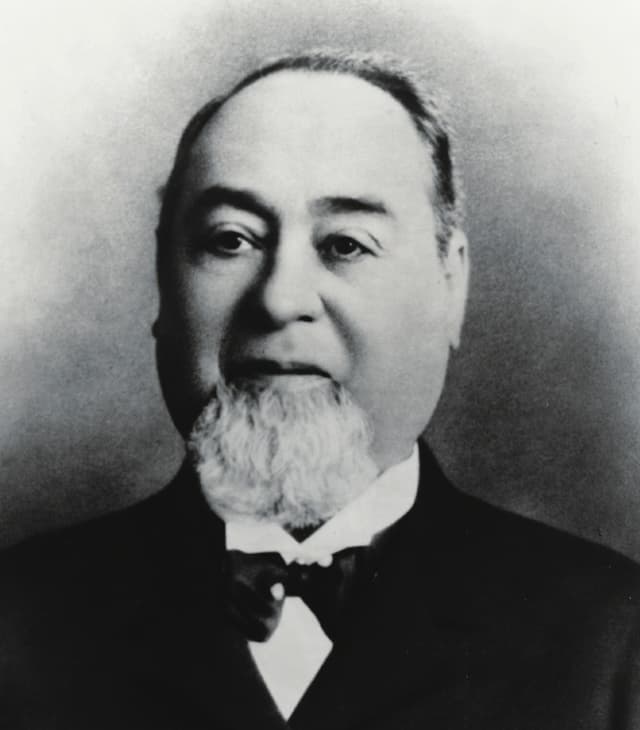
Levi Strauss
Levi Strauss and Company
Born in Bavaria in 1829, Levi Strauss immigrated to America with his mother, Rebecca, in search of better opportunities. After two decades mastering the dry goods industry, he identified the potential for durable, riveted pants, which led to the founding of Levi Strauss & Company in 1853. His resilience in the face of economic downturns and his commitment to maintaining family integration and independence from external credit systems allowed his business to thrive despite the challenges of the era. By the end of his life in 1902, Strauss had transformed the fashion landscape with his innovative designs, creating a brand that would become synonymous with quality denim and setting the stage for future entrepreneurs to understand the importance of expertise and perseverance in building successful enterprises.
Core Principles
competitive advantage
Protect intellectual property when you have a unique advantage. The 17-year patent on riveted pants created a moat that generated 33-40 percent profit margins.
Jacob Davis and Levi Strauss patented the rivet reinforcement process. For 17 years, they were the only manufacturer allowed to produce riveted overalls, commanding premium wholesale prices of $19.50 per dozen with exceptional profit margins that competitors could not match.
customer obsession
Recognize that wealth is ultimately a means to freedom and autonomy, not an end in itself. Different people define this freedom differently, but the underlying desire is universal.
Gold prospectors entered the Gold Rush not simply to accumulate riches, but to escape physical labor, rigid office work, or dependence on employers. The deeper motivation was economic autonomy and participation in free community. Understanding this psychology of why customers and employees seek what they seek allows you to serve them more effectively.
“At the conscious level, the rushers thought only of holding the gold in their hands, but at the deeper level of true desire, gold meant freedom.”
finance
Act as a banker to your customers when local financial institutions are unavailable or unreliable. This creates loyalty and enables growth in frontier markets.
During the Gold Rush, retail stores collected gold dust from customers and forwarded it to Levi, who acted as their banker, weighing, measuring, paying their suppliers' invoices, and crediting their accounts. This service made him indispensable to the entire supply chain and gave him visibility into all commerce in the region.
“In essence, Levi and other merchants acted as bankers for their own customers.”
Maintain independence from external credit systems when possible, especially if you face systemic prejudice. Family integration and internal capital flow provide resilience others lack.
Credit rating agencies of the time issued warnings against doing business with Jewish merchants. Levi avoided this trap entirely because his suppliers were his own brothers. During financial panics when credit tightened, he could continue operating while competitors faced collapse.
leadership
Empower your team members to make significant decisions in the founder's absence. Decentralized authority speeds decision-making and demonstrates trust.
Levi's business operated with a principle of delegation where the chief salesman was empowered to act on purchases of up to $500,000 without consulting the principals. A newspaper profile noted this with approval, calling it a surprisingly modern approach that allowed the business to serve large orders same-day.
“In the absence of the principles, if a purchaser should call in to buy $500,000 worth of goods, the chief salesman is empowered to act in every particular as if he was a member of the firm.”
Communicate growth wisdom through quiet observation rather than lengthy explanation. Sometimes a single measured sentence teaches more than a lecture.
When Joe, an enthusiastic salesman, reported an excellent year to Levi, Levi listened patiently and then offered a single observation: 'Remember, Joe, the more business you do, the more problems and trouble you'll have.' Joe never forgot this conversation and spoke of Levi with admiration for years afterward.
“Remember, Joe, the more business you do, the more problems and trouble you'll have.”
marketing
Use symbols and visual branding for markets where literacy or language fluency is limited. Images communicate across all barriers to entry.
Many miners and laborers in California were either illiterate or did not speak English as their first language. The two-horse trademark showing horses attempting to tear apart riveted overalls communicated the product's strength without requiring reading ability, similar to how a pawn shop uses three balls or a barber pole uses stripes.
mindset
Understand that immigration and the pursuit of freedom create a unique entrepreneurial energy. Restricted populations that escape constraints often display exceptional drive.
Levi's family fled Bavaria where Jewish citizens faced systematic legal restrictions on occupation, marriage, worship, and assembly. Upon arriving in America with freedom to choose their own path, they systematically moved from peddling to storefronts to wholesale to manufacturing. This freedom, after experiencing constraint, bred exceptional motivation.
“The favorable news that I've received from my stepbrothers in America has convinced me to follow them, even though I do not have at this time a specific occupation. But my brothers will help. And I thus joined my mother in her plea.”
Embrace patience and accept that success often requires enduring perceived hardship for long periods before results materialize. Freedom and autonomy are the true reward, not quick riches.
Levi's family fled Bavaria seeking religious tolerance and economic autonomy. They endured dangerous sea voyages, started as peddlers, slowly worked their way to storefronts, then became wholesalers. This multi-decade progression, repeated across many immigrant families, created the foundation for later prosperity.
“If they did experience hardship, they knew it wasn't forever. It was just something that had to be endured on the way to the ultimate goal, self-employment.”
product
Design products to be both familiar and new simultaneously. Innovation succeeds when it enhances what customers already understand rather than forcing complete behavior change.
The riveted overalls were not a radical departure from traditional work pants. Jacob Davis used familiar duck fabric in a familiar silhouette, adding only the novel element of reinforced rivets at pocket corners. This allowed customers to understand the benefit immediately without requiring re-education about the entire product.
“The pants were not so strange that men would not want to try them. The rivets were simply an addition to the typical work pants they were used to buying.”
resilience
Recognize that a successful business often requires bearing witness to hardship and enduring multiple financial catastrophes. Economic booms and busts are inevitable, not exceptions.
Levi survived multiple financial panics, the loss of two ships carrying nearly $4 million in treasure, banking failures, and local tax increases during the San Francisco financial crisis of 1855 and the national panic of 1857. Rather than being destroyed by these events, he positioned his business to withstand them through family relationships and vertical integration.
sales
When entering a new market or venture, start by calling on existing established players rather than attempting to build an entirely parallel infrastructure.
When Levi arrived in San Francisco with no contacts, he did not try to build his own retail network. Instead, he walked door to door to existing retailers, hotels, and restaurants and offered them wholesale goods. This allowed him to build distribution rapidly without capital-intensive store development.
strategy
Move most of your business and attention toward initiatives that strengthen the foundational economy and infrastructure of the regions you serve.
Levi refused to diversify into unrelated ventures. His investments in banking, real estate, and politics all aligned with developing California's trade infrastructure and removing restrictions on commerce. He viewed himself as building the state's economic foundation, not seeking disparate opportunities.
Position yourself in the infrastructure layer of a revolution, not the center of it. Merchants selling to miners made more reliable profits than miners seeking gold.
Rather than joining the gold rush to mine, Levi and his brothers supplied the miners with goods. This pickaxe retailing approach, selling tools and supplies to those engaged in the revolutionary activity, proved far more profitable and sustainable than participating in the gold rush directly.
“The best way to make money in mining was not to squat in a snow-fed river, but to have dry clothes ready for those who did.”
Build deep expertise in your industry before pursuing major opportunities. Levi spent 20 years mastering the dry goods business before recognizing the potential of riveted pants.
By the time Jacob Davis approached him with the riveted pants idea, Levi had spent two decades importing and distributing clothing across a vast network stretching from Montana to Japan. This deep knowledge of customer needs, geography, and market dynamics allowed him to recognize the opportunity immediately and act decisively within three weeks.
“When Levi's deep knowledge of his customers' needs met Jacob's riveted pants, it's no wonder Levi jumped on the opportunity.”
Frameworks
The Peddler's Ladder
A multi-stage progression of immigrant commercial success beginning with door-to-door peddling (lowest capital requirement), advancing to retail storefronts, then wholesale distribution, then manufacturing, and finally to controlling entire supply chains and employing relatives. Each rung required mastery of the previous stage before advancement.
Use case: Understanding how capital-constrained newcomers build enterprises in unfamiliar markets by starting with maximum mobility and zero fixed costs, then gradually increasing scale and infrastructure.
Pickaxe Retailing
A strategy of profiting from revolutionary activity by providing essential infrastructure and supplies to participants rather than competing directly in the revolution. During a gold rush, sell tools and clothing to miners rather than mining yourself. During an internet revolution, sell computing resources and services to technology builders.
Use case: Identifying which layer of an economic transformation offers the most reliable and sustainable profits, avoiding the volatility of direct participation in speculative frontiers.
Familiar-Yet-Novel Product Design
Create products that are recognizable improvements on existing solutions rather than complete departures from what customers already understand. The riveted overalls maintained the silhouette and material of traditional work pants while adding only the novel element of reinforced corners, making adoption frictionless.
Use case: Launching innovations that must achieve rapid market penetration and high adoption rates without requiring customers to fundamentally re-learn how to use the product.
Symbol-Based Branding for Cross-Linguistic Markets
Use visual symbols and trademarks to communicate product benefits to populations with varying literacy levels and language fluency. A two-horse image showing horses failing to tear apart riveted pants communicates durability across all language and education barriers.
Use case: Marketing to diverse populations where reading ability, language fluency, and cultural context vary widely, such as immigrant communities, frontier markets, or international expansion.
Family Vertical Integration
Maintain supply chain independence through family relationships across multiple stages of production. Levi's brothers manufactured goods in New York while Levi distributed and sold in California. This eliminated exposure to external credit systems and allowed survival during financial crises when credit tightened.
Use case: Building resilience against external financial shocks and systemic discrimination in credit markets by keeping capital and decision-making within family networks rather than relying on outside financing.
Stories
A widow named Rebecca, facing restrictions in Bavaria and poor prospects for her children, made the extraordinary decision to board a dangerous ship with her young son Levi and risk death during the transatlantic voyage. She had to flee a system that forbade her family from practicing their traditional trades and limited their future options. The willingness to risk everything for freedom became the defining characteristic of their family's subsequent entrepreneurial success.
Lesson: Desperation combined with hope for freedom creates the psychological foundation for exceptional drive and persistence. Those who escape systematic constraint often display unmatched determination because they understand what they've escaped.
In 1857, Levi arranged shipment of nearly $2 million in gold on the steamship Central America. The ship was destroyed in a hurricane off North Carolina, killing over 400 passengers and losing $40 million in total treasure from 30+ merchants to the Atlantic floor. This triggered a national financial panic that took two years to recover. Yet Levi not only survived but prospered because his capital was controlled internally and his suppliers were his own brothers.
Lesson: Catastrophic events that destroy entire competitor ecosystems reveal the structural resilience of vertically integrated family businesses. The same disaster that bankrupts external capital-dependent competitors becomes merely another expense for those with internal control.
Levi spent 20 years as a wholesaler and distributor of dry goods, building relationships and understanding the specific clothing needs of customers across Montana, Nevada, Arizona, California, the Pacific Northwest, Canada, Mexico, Hawaii, and Japan. When Jacob Davis approached him with the riveted pants idea, Levi recognized the opportunity instantly and committed capital within three weeks because he already understood the market with exceptional depth.
Lesson: Opportunities appear obvious in hindsight only to those who have already spent years learning the domain. The founder with 20 years of experience can recognize in three weeks what the newcomer would take years to evaluate, if they ever find it at all.
When a gold shipment failed to arrive on time due to a lost ship, Levi's supply chain continued because his brothers in New York could continue manufacturing and shipping replacements without demanding immediate payment from an external creditor. During the 1857 financial panic, when banks called in loans and credit disappeared, Levi continued operating at full capacity because he owed nothing to external capital sources.
Lesson: Financial independence and family integration in business is not a constraint on growth, it is resilience. External capital may appear to enable faster growth in good times, but internal capital enables survival in catastrophic times.
Notable Quotes
“The favorable news that I've received from my stepbrothers in America has convinced me to follow them, even though I do not have at this time a specific occupation. But my brothers will help. And I thus joined my mother in her plea.”
At age 17 or 18, petitioning the Bavarian government for permission to emigrate to America, expressing trust in family and hope despite having no specific job prospects.
“The pants were not so strange that men would not want to try them. The rivets were simply an addition to the typical work pants they were used to buying.”
Explaining how the riveted overalls succeeded by being both familiar and innovative simultaneously, maintaining the expected silhouette while adding only the novel element of reinforced pockets.
“Remember, Joe, the more business you do, the more problems and trouble you'll have.”
Levi's quiet observation to an enthusiastic salesman who had reported an excellent year, imparting wisdom about the hidden costs of growth.
“In the absence of the principles, if a purchaser should call in to buy $500,000 worth of goods, the chief salesman is empowered to act in every particular as if he was a member of the firm.”
Describing Levi's decentralized organizational structure, which allowed large decisions to be made instantly by empowered staff without consulting the founder.
“If a city merchant should call at 8 o'clock in the morning, he might have purchases of the amount of $50,000 and have every article delivered to his store by 1 o'clock in the afternoon on the same day. If time is money, there is no need of argument on this point.”
Highlighting the operational efficiency and responsiveness of Levi's business, showing how he had optimized his warehouse and fulfillment system for speed.
Frequently Asked Questions
What are Levi Strauss's key business principles?▼
Levi Strauss's core principles include: Protect intellectual property when you have a unique advantage. The 17-year patent on riveted pants created a moat that generated 33-40 percent profit margins.. Recognize that wealth is ultimately a means to freedom and autonomy, not an end in itself. Different people define this freedom differently, but the underlying desire is universal.. Act as a banker to your customers when local financial institutions are unavailable or unreliable. This creates loyalty and enables growth in frontier markets.. Founder Almanac has cataloged 15 total principles from Levi's career.
What can entrepreneurs learn from Levi Strauss?▼
Key lessons from Levi Strauss include: Desperation combined with hope for freedom creates the psychological foundation for exceptional drive and persistence. Those who escape systematic constraint often display unmatched determination because they understand what they've escaped.. Explore 4 stories and 5 frameworks from Levi's experience.
What is Levi Strauss known for in business?▼
Born in Bavaria in 1829, Levi Strauss immigrated to America with his mother, Rebecca, in search of better opportunities. After two decades mastering the dry goods industry, he identified the potential for durable, riveted pants, which led to the founding of Levi Strauss & Company in 1853. His resilience in the face of economic downturns and his commitment to maintaining family integration and independence from external credit systems allowed his business to thrive despite the challenges of the era. By the end of his life in 1902, Strauss had transformed the fashion landscape with his innovative designs, creating a brand that would become synonymous with quality denim and setting the stage for future entrepreneurs to understand the importance of expertise and perseverance in building successful enterprises.
More Fashion & Luxury Founders




Want Levi's advice on your business?
Our AI has studied Levi Strauss's biography, principles, and decision-making frameworks. Ask any business question.
Start a conversation