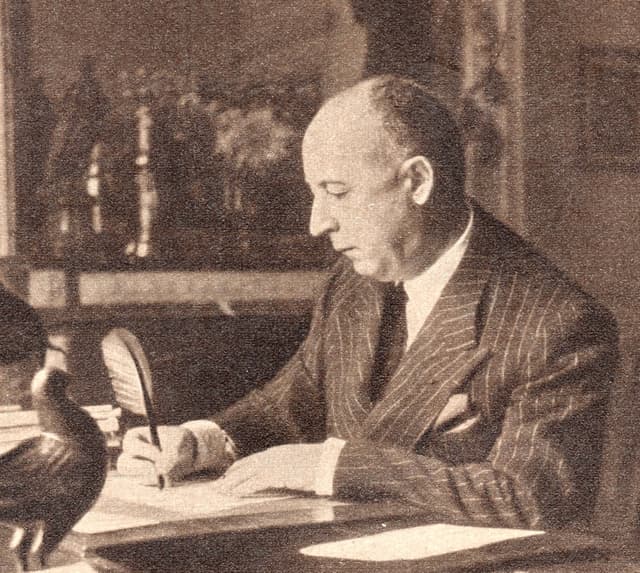
Christian Dior
Christian Dior
A visionary in the fashion and luxury industry, Christian Dior revolutionized women's fashion with his debut collection in 1947, introducing the iconic "New Look" silhouette that emphasized femininity and elegance. Despite a tumultuous personal background, including the bankruptcy of his father's business and the loss of family members, Dior leveraged these challenges to establish a high-end fashion house that prioritized craftsmanship and artistry. He famously stated, "What you need and what I would like to run is a craftsman workshop in which we recruit the very best people in the trade," underscoring his commitment to excellence. By investing heavily in talent and innovation, Dior positioned himself to capitalize on opportunities in a post-war world, ultimately reestablishing Paris as the epicenter of luxury fashion. Today, his legacy serves as an inspiration for entrepreneurs to embrace risk and recognize the potential for growth amid adversity.
Core Principles
customer obsession
Understand that true success means building something that resonates deeply with the people it serves. This connection and appreciation is more valuable than any metric or award.
Dior reflected that all his pleasure arose from the fact that his dresses were being appreciated by the public. The moment of launch when the response was overwhelmingly positive was described as exceeding any other triumph he would ever achieve.
“All my pleasure arose from the fact that my dresses were being appreciated by the public. As long as I live, whatever triumphs I win, nothing will ever exceed my feelings at that supreme moment.”
hiring
Invest massively in recruiting and retaining the absolute best people in your field, regardless of cost.
Dior committed to employing only the finest experts found in France, people who would refuse to let anything below world standards leave their hands. The house grew to 1,000 of the finest experts gathered under one roof by his death. He never stopped recruiting excellence and paid whatever it cost.
“With no expense spared and endless trouble taken, Dior recruited and continued to employ the best people to be found in France, men and women who would die rather than turn out an article which was in the tiniest degree below the best in the world.”
Build your team as an entire company of A-players, people who care deeply about excellence and are willing to die rather than produce work below world-class standards. This is the foundation of sustained competitive advantage.
Dior recruited and continued to employ the best people in France, men and women who would rather die than turn out a piece of clothing below world standards. He built what was essentially the Pixar of fashion houses, creating a culture where every member held themselves and others to extraordinary standards.
“Christian Dior recruited and continued to employ the best people to be found in France, men and women who would rather die than turn out a piece of clothing which was in the tiniest degree below the best in the world.”
Hire people who are fanatical about excellence in their domain and who are complementary to your own strengths and weaknesses. Assemble a team of specialists who care more about their craft than about external concerns.
Dior hired Raymond, who played reason to his fantasy and discipline to his freedom. He hired Burkhard, who was superbly indifferent to politics and finance and cared only about fashion elegance. He hired Marguerite, who was so obsessed with perfection she would stitch and cut a dress a hundred times until satisfied.
“I knew that if I were to emerge victorious, I had to be equipped with a first class staff. She plays reason to my fantasy, order to my imagination, discipline to my freedom, foresight to my recklessness.”
innovation
Stand out through bold differentiation, especially after periods of scarcity or constraint. Do the opposite of what the market expects.
After World War II, Paris was devastated and austere. Dior launched his revolutionary New Look using prodigious quantities of precious materials, directly spitting in the face of postwar egalitarianism. He said I want to make the rich feel rich again. This counterintuitive move became the most successful collection in fashion history because he recognized the psychological hunger for beauty after deprivation.
“He spat in the face of postwar egalitarianism and said, I want to make the rich feel rich again.”
Trust your instinctive reactions to ideas and capture them quickly without over-intellectualizing. The initial gut response to an idea often contains valuable truth that gets lost in analysis.
Dior practiced capturing his instinctive reactions to designs without subjecting them to excessive critique or analysis. This allowed him to preserve the creative energy and authenticity of his ideas before his analytical mind could diminish them.
“I give way to my instinctive reactions.”
Develop a daily practice of capturing ideas immediately when they strike. Create systems that allow you to preserve fleeting inspiration and insights before they disappear.
Dior described constantly sketching ideas everywhere: in bed, in the bath, at meals, in his car, by day and by night. Like da Vinci observing patterns in the Florentine countryside, he captured visual inspiration as it arose, giving himself a continuous stream of material to develop.
“I scribble everywhere, in my bed, in my bath, at meals, in my car, on foot, by day and by night. My dresses take shape all around me as my fancy works on whatever it happens to see.”
leadership
When presenting ambitious ideas, clearly articulate both the vision and the risks to attract the right kind of partner.
Dior pitched Boussac not as a manager of a factory but as someone who would recruit the best artisans to rebuild Paris as a luxury salon with the highest standards. Dior explicitly stated it would cost a great deal of money and entail much risk. Boussac invested not despite but because of this clarity. This mirrors Shackleton's famous job posting for polar explorers emphasizing danger and sacrifice.
“What you need and what I would like to run is a craftsman workshop in which we recruit the very best people in the trade to reestablish in Paris a salon for the greatest luxury and the highest standards of workmanship. It will cost a great deal of money and entail much risk.”
marketing
Secrecy and mystery around your work can generate more valuable word-of-mouth publicity than any paid advertising. The less you seek publicity, the more actively it may pursue you.
Dior intentionally worked in relative secrecy with no budget for publicity, yet this approach created a powerful whispering campaign. His biggest breakthrough came from an unplanned article in Life Magazine, demonstrating that avoiding publicity often attracts it more effectively.
“It is widely and quite erroneously believed that when the House of Christian Dior was launched, enormous sums were spent on publicity. On the contrary, not a single penny was allotted to it. The relative secrecy in which I chose to work aroused a positive whispering campaign.”
mindset
Be willing to feel the full weight and responsibility of your work. The stakes feel real because they are real. This emotional engagement drives excellence.
Dior described nearly killing himself repeating that if the models go wrong, it is after all his fault and nobody else's. This sense of complete ownership and responsibility, while emotionally taxing, drove his obsessive commitment to excellence.
“I nearly kill myself repeating over and over and over again that if the models go wrong, it is after all my fault and nobody else's.”
Make yourself a big target for luck by being curious and maintaining visibility in your industry, even while building.
Dior took random jobs hovering on the fringes of fashion, which kept him visible and curious. His fortune-telling belief combined with this visibility created the conditions where Marcel Boussac could be told about him. Paul Graham's principle states that great creators discover what to work on through chance meetings and books they happen to pick up.
“When you read biographies of people who've done great work, it's remarkable how much luck is involved. They discover what to work on as a result of a chance meeting or by reading a book they happen to pick up.”
Identify yourself as a craftsman pursuing excellence rather than as an artist pursuing expression. This mindset focuses you on meeting rigorous standards and serving customers rather than seeking personal validation.
Dior repeatedly emphasized his identity as a craftsman focused on workmanship rather than as a revolutionary artist. He said Boussac realized he was dealing with a conscientious craftsman, not a megalomaniac. This framing kept him grounded in excellence and customer value.
“Far from wanting to revolutionize fashion, I was chiefly concerned with producing a high standard of workmanship. I aimed at being considered a good craftsman.”
View your work as having a profound, almost spiritual dimension. The daily activity of your business should feel meaningful and consequential, not merely transactional.
Dior described his work as ephemeral architecture dedicated to the beauty of the female body. This framing elevated routine fashion design into something profound and beautiful, which sustained his engagement and excellence.
“I think of my work as ephemeral architecture dedicated to the beauty of the female body.”
Structure your work in cycles of intense focus followed by extended rest. Sprint hard on what matters, then step away completely to recharge before the next cycle begins.
Dior described himself as both very busy and very lazy, working intensely during collection preparation with constant crisis management, then taking long extended vacations. This sprint-rest rhythm allowed him to sustain his high standards and emotional energy across multiple seasons.
“To me, peace and quiet are a necessity of life. If I am in one sense a very busy man, in another sense I'm a very lazy one. The application and care which I devote to my work are rooted in my desire to be finished with it as soon as possible.”
operations
Design your business model and physical space to support craftsmanship and high standards. Choose a craftsman workshop structure over a factory structure when quality is your differentiator.
When describing his vision to Boussac, Dior insisted on building a craftsman workshop, not a clothing factory. This structural decision enabled him to maintain the highest standards of workmanship and excellence throughout the organization.
“I envisioned my house as a craftsman's workshop rather than a clothing factory. I wanted every element to be of the highest standard.”
resilience
Opportunity often appears after loss or crisis. Position yourself to recognize and seize it when it arrives.
Christian Dior failed multiple times before his breakthrough: his brother was institutionalized, his mother died, his father went bankrupt, and his art gallery failed. Only through these losses was he free to pursue fashion. His fortune teller had told him women would be lucky for him, and he believed it enough to stay curious and available when opportunity struck.
“Without this financial disaster, Dior would probably have spent his life as a middle-ranking art dealer and died unknown.”
strategy
Create clarity about what you will and will not do. Dior refused to resurrect an existing failing brand and instead insisted on building something completely new from scratch with his own standards and vision.
When offered the chance to revive the Gaston fashion house, Dior rejected the path of fixing something old. He told Boussac he wanted to create a new fashion house under his own name where every element would be new, not a compromise with legacy constraints.
“I was not meant by nature to raise corpses from the dead. I wanted a house in which every single thing would be new.”
Location and clustering matter. Position yourself in the geographic center of your industry where the best talent naturally congregates. This gives you access to a continuous flow of exceptional people.
Dior recognized that if you were interested in fashion in the 1920s-1950s, you needed to be in Paris. This central location gave him access to the finest designers, seamstresses, and craftspeople in the world, who clustered there because that's where serious fashion was happening.
Study the masters in your field and understand the history of your industry. Learn from what worked before you, but use that knowledge to forge your own path rather than imitate.
Dior studied Coco Chanel, Balenciaga, and other great designers, calling Balenciaga the master of them all. He drew inspiration from their excellence while developing his own distinct aesthetic and approach.
Frameworks
The Opportunity Magnet Principle
Position yourself at the intersection of your industry and your interests, stay curious, remain visible to decision-makers, and be ready when opportunity arrives. Dior took adjacent jobs in fashion while his primary art business failed, making him visible to Boussac. Opportunity struck because he was in the right place with the right reputation.
Use case: Navigating career transitions or breaks, building visibility before breakthrough moments
The Alter Ego Framework
Create a separation between your personal identity and your professional/creative identity. Allow the professional identity to operate with confidence and purpose while your personal identity remains humble and doubtful. Over time, these identities may merge, but initially the separation allows you to function at a higher level. Dior created Christian Dior the designer as a separate character from Christian Dior the person, allowing him to overcome his imposter syndrome.
Use case: When imposter syndrome or self-doubt is preventing you from taking necessary action or performing at your potential level
The Sprint-Rest Cycle
Alternate between periods of intense, obsessive focus on your core work and extended periods of complete rest and detachment. During sprint periods, bring maximum care, enthusiasm, and troubleshooting. During rest periods, step away entirely to allow recovery and reflection. This rhythm sustains both creative output and mental health over decades.
Use case: When building a business that requires sustained creative excellence or high standards over the long term
The Craftsman Philosophy
Frame your work as craftsmanship rather than art. This orients you toward external standards of excellence and customer value rather than personal expression. It emphasizes the importance of skill development, attention to detail, and meeting rigorous standards consistently over time.
Use case: When you want to focus your team on excellence and high standards rather than on innovation or disruption
Stories
Christian Dior's father ran a profitable liquid manure factory. His brother was institutionalized, his mother died, his father went bankrupt, and his art gallery failed. All these losses freed him from expectations and made him available when Marcel Boussac, a textile magnate, offered him backing to rebuild Paris as a luxury fashion center.
Lesson: Crisis and loss create opportunity. The obstacles that derail most people clear the path for those who stay curious and available. Dior's failures positioned him perfectly for his moment.
Christian Dior's family fortune, built over 100 years starting from importing bat guano in 1832, collapsed during the Great Depression in the 1930s when his father went bankrupt. This financial catastrophe left him afraid of risk and entrepreneurship. However, this same failure liberated him from the path of being a middle-ranking art dealer, freeing him to pursue fashion design instead.
Lesson: What feels like devastating failure often contains the seeds of your greatest opportunity. The destruction of one path forces exploration of another path you might never have otherwise chosen. Paradoxically, the family bankruptcy that terrified Dior was essential to his eventual success.
When Marcel Boussac, a famous textile magnate, offered to fund Dior's vision of a new fashion house, Dior became so terrified of the responsibility and risk that he sent a telegram breaking off negotiations entirely. His fortune teller ordered him to accept the offer, overriding his paralysis. This external directive gave him the push he needed to move forward despite his overwhelming self-doubt.
Lesson: When imposter syndrome and fear threaten to stop you from seizing a once-in-a-lifetime opportunity, sometimes you need an external voice of authority to override the internal voice of doubt. External structure can be permission to proceed.
Dior worked for 10 years under designer Lucien Lelong in a middle-level position. He had no responsibilities for production or execution, just design work. Eventually, he began to wonder if he was simply making another man rich with his own talents. Observing peers like Pierre Balmain leave to start their own houses finally sparked the question: what about my own ambition?
Lesson: Seeing others around you succeed in building their own ventures often triggers the realization that you too might want to create rather than serve. Sometimes the catalyst for your own ambition is not internal drive but the visible example of peers doing what you thought was impossible.
When Dior presented his initial collection after building his team and vision, he was so nervous about potential failure that he stuffed his ears to avoid hearing the audience response too soon. He was terrified of feeling confident too soon or being disappointed. When the response turned out to be overwhelmingly positive and described as the most successful fashion collection launch in history, he reflected that nothing he would ever achieve would exceed the joy of that moment.
Lesson: The intensity of your emotional engagement with your work, even the fear and anxiety, is a signal that what you're creating matters deeply to you. That authenticity and care translates into work that resonates with others. The payoff for that emotional risk is profound.
Notable Quotes
“What you need and what I would like to run is a craftsman workshop in which we recruit the very best people in the trade to reestablish in Paris a salon for the greatest luxury and the highest standards of workmanship. It will cost a great deal of money and entail much risk.”
Pitching his vision to Marcel Boussac, explicitly stating the cost and risk required
“We need your example in all that is best in our trade.”
Dior's plea to Balenciaga to not retire, recognizing his unique value to the industry
“I'm not interested in managing a clothing factory. What you need and what I would like to run is a craftsman workshop in which we recruit the very best people in the trade.”
Dior refusing the conventional path and instead proposing excellence-first approach to Boussac
“I was not meant by nature to raise corpses from the dead.”
Explaining his refusal to resurrect the failing Gaston fashion house, insisting instead on creating something entirely new
“You must create the house of Christian Dior, whatever the conditions. Nothing anyone will offer you later will compare with the chance which is open to you now.”
The advice that pushed Dior to overcome his paralyzing self-doubt and accept Boussac's investment offer
“I knew that if I were to emerge victorious, I had to be equipped with a first class staff.”
Explaining his deliberate strategy to assemble only the most talented people in France for his fashion house
“She plays reason to my fantasy, order to my imagination, discipline to my freedom, foresight to my recklessness.”
Describing Raymond, his second-in-command, as his perfect complement and why her hiring was essential
“I scribble everywhere, in my bed, in my bath, at meals, in my car, on foot, by day and by night.”
Describing his practice of constantly capturing ideas and designs in sketches throughout his day
“Clothes are my whole life. Ultimately, everything I know, see, or hear, every part of my life turns around the clothes which I create.”
Expressing the totality of his obsession with his work
“I think of my work as ephemeral architecture dedicated to the beauty of the female body.”
Articulating his elevated vision of what fashion design represents
Frequently Asked Questions
What are Christian Dior's key business principles?▼
Christian Dior's core principles include: Understand that true success means building something that resonates deeply with the people it serves. This connection and appreciation is more valuable than any metric or award.. Invest massively in recruiting and retaining the absolute best people in your field, regardless of cost.. Build your team as an entire company of A-players, people who care deeply about excellence and are willing to die rather than produce work below world-class standards. This is the foundation of sustained competitive advantage.. Founder Almanac has cataloged 23 total principles from Christian's career.
What can entrepreneurs learn from Christian Dior?▼
Key lessons from Christian Dior include: Crisis and loss create opportunity. The obstacles that derail most people clear the path for those who stay curious and available. Dior's failures positioned him perfectly for his moment.. Explore 5 stories and 4 frameworks from Christian's experience.
What is Christian Dior known for in business?▼
A visionary in the fashion and luxury industry, Christian Dior revolutionized women's fashion with his debut collection in 1947, introducing the iconic "New Look" silhouette that emphasized femininity and elegance. Despite a tumultuous personal background, including the bankruptcy of his father's business and the loss of family members, Dior leveraged these challenges to establish a high-end fashion house that prioritized craftsmanship and artistry. He famously stated, "What you need and what I would like to run is a craftsman workshop in which we recruit the very best people in the trade," underscoring his commitment to excellence. By investing heavily in talent and innovation, Dior positioned himself to capitalize on opportunities in a post-war world, ultimately reestablishing Paris as the epicenter of luxury fashion. Today, his legacy serves as an inspiration for entrepreneurs to embrace risk and recognize the potential for growth amid adversity.
More Fashion & Luxury Founders

Want Christian's advice on your business?
Our AI has studied Christian Dior's biography, principles, and decision-making frameworks. Ask any business question.
Start a conversation